Real Estate Franchise in India – Complete Guide (2026)
India's real estate brokerage market is worth ₹1,00,000 Crore. And roughly 90% of it is run by unorganised brokers — working out of 100-square-foot offices with no CRM, no training, no brand recognition, and no system to speak of.
That single stat should make you pause.
When 90% of a ₹1 Lakh Crore market is unorganised, the opportunity for organised players isn't just "good." It's generational. RERA changed the rules. Buyers now demand transparency. NoBroker proved people will pay money specifically to avoid dealing with traditional brokers. And yet, the brokerage industry itself hasn't evolved.
This is exactly where a real estate franchise in India fits — not as some passive investment where you sit back and wait for cheques, but as a structured business model where you build a team, follow a proven system, and earn from multiple revenue streams. Without spending 3 years and ₹50 Lakhs learning lessons that global franchises already solved decades ago.
This guide breaks down everything: what a real estate franchise actually is, how the money flows, what it costs across different brands, who the major players are (with real pricing data), and how to decide if this is the right move for you.
No motivational fluff. No "unlock your potential" nonsense. Just data, logic, and a clear-eyed look at the opportunity.
What Exactly Is a Real Estate Franchise?
A real estate franchise is not a "job." It's not a "course." And it's definitely not a builder tie-up where you push one developer's inventory.
Here's the simplest explanation: you buy the rights to operate under an established real estate brand — their name, their systems, their training, their technology, their network. You set up an office in your city. You recruit agents (sub-brokers, salespeople). Those agents do the transactions — residential resale, primary sales, leasing, commercial, whatever your market demands. And you earn from their activity.
Think of it this way. Real estate has only two jobs: source the lead and close the lead. A franchise gives you the infrastructure for both — marketing support and network for sourcing, brand trust plus training for closing. Your job as the franchise owner is to manage the office, build the team, and keep the machine running.
You're not necessarily doing deals yourself (though you can, especially early on). You're building a business that does deals.
This model works because Indian real estate has a massive skills gap. 85-90% of brokers in India have zero formal training. No process for follow-ups. No CRM. No marketing budget. No RERA compliance awareness. A franchise gives you — and more importantly, your agents — what they don't have: structure, training, and a system that actually converts.
The 1973 Question That Started It All
Back in 1973, a man named Dave Liniger asked himself a simple question: Is real estate actually hard — or is it just unstructured for most people?
The US economy was booming. Real estate was going up. But local brokerage companies were still struggling and failing left and right. Why? Liniger identified three problems that are eerily identical to what India faces today:
- No system or support structure for brokers
- Non-transparent ways to collaborate on deals
- People leaving salaried jobs to start their own firms, only to crash because building from scratch is brutally expensive
His answer was REMAX — a franchise system where agents could operate under one brand, share infrastructure costs, and focus on what they're actually good at: selling real estate. That model now operates in 112+ countries with 9,200+ franchise offices and over 1,45,835 agents. NYSE-listed. 52+ years and counting.
India in 2026 is where America was in the 1970s — a booming market with a broken brokerage structure. The same question applies: real estate in India isn't hard. It's just unstructured for 90% of the people in it.
Why India Needs Organised Brokerages — Right Now
If you've ever bought or sold property in India, you already know the pain. Random brokers calling from numbers you never shared. Site visits with zero preparation. Agents who can't explain a basic BBA clause. Commission negotiations that feel like a sabzi mandi.
Three things are forcing this market to change — fast.
RERA made transparency non-negotiable. Every state now requires registration for brokers and projects. The cowboy era of Indian real estate is ending. Slowly, sure — but it's ending. Brokers who don't professionalise will get pushed out. It's not a question of "if."
Buyers got smarter. Thanks to 99acres, MagicBricks, and Housing.com, buyers walk in with pricing data, locality analysis, and builder reviews before they even pick up the phone. The old "trust me bhai, this is the best deal" approach doesn't work anymore. Buyers want a brand they can hold accountable — not someone who'll switch off their phone after the commission clears.
NRI money is flooding in. Of the entire $450 billion in real estate transactions in India, NRI share already ranges from 8% to 22%. Industry projections say this could reach 25% by 2030 — meaning one-fourth of all Indian real estate transactions will be driven by NRIs. And NRIs don't call the local Sharma ji from the gali. They look for recognisable, trustworthy brands with professional operations. If you don't have a brand, you simply don't exist for the NRI buyer.
Add it up: a massive market, mostly unorganised, with regulatory pressure and buyer expectations both demanding professionalism. The question is not whether organised brokerage will dominate India. It will. The question is whether you'll be the one leading it in your city.
How the Franchise Income Model Actually Works
Let's kill the mystery. A real estate franchise generates income from three streams, and they compound as you grow.
Stream 1: Commission Share from Agent Transactions
Every time one of your agents closes a deal, you earn a percentage of their commission. In most franchise models, this ranges from 14% to 34%, depending on the system and the agent's tier.
Quick math. Say an agent earns ₹2,00,000 commission on a transaction. At 25% share, you pocket ₹50,000 from that single deal. Now scale it. If you have 10 agents and each does one deal a month, that's ₹5,00,000/month hitting your account from this stream alone.
For context, the global REMAX average is 11.5 transactions per agent per year. Multiply that across a team and the numbers start making serious sense.
Stream 2: Monthly Agent Desk Fees
Your agents pay a monthly fee for using your infrastructure — brand, CRM, marketing support, office space. This typically ranges from ₹3,000 to ₹6,000 per agent per month.
With 10 agents at ₹5,000 each, that's ₹50,000/month in recurring revenue regardless of whether deals close that month. Not massive on its own, but it covers fixed costs and creates a baseline you can count on.
Stream 3: Value-Added Services
As your expertise grows, you earn from deal structuring, property mandates, developer collaborations, and consulting. This stream is harder to quantify in month one, but franchise owners who've been operating for 2-3 years often say this becomes their most profitable line.
The critical insight: all three streams compound with team size and time. Add one more agent — all three numbers go up. Add a developer relationship — streams 1 and 3 go up. Initially, your focus is simple: implement the model, close your first few deals, build confidence, create consistency. Over roughly a year, you expand activities, collaborate with more developers, and structure more deals. Nothing is forced from day one. This is not about one deal — it's about building a structured way of doing real estate where results become more rewarding with time.
What Does a Real Estate Franchise Cost in India?
Here's a transparent breakdown. No fine print, no "contact us for pricing" games.
| Cost Component | Typical Range | Notes |
|---|---|---|
| Franchise Fee (one-time) | ₹8–40 Lakhs | Varies by brand and city tier. REMAX: ₹8-15L for 5 years. REGrob: ₹13.5-40L for 3 years. |
| Monthly Royalty | 5-8% of office commission | REMAX charges 6%. Some brands charge flat fees instead. |
| Per-Agent Fee to Franchisor | ₹1,000–3,000/month | Separate from what you charge agents for desk fees. |
| Office Setup | ₹3–10 Lakhs | Depends on city. Some models offer flexible/shared office options. |
| Working Capital (first 6 months) | ₹2–5 Lakhs | Marketing, salaries if any, operational costs. |
| Total to Get Operational | ₹15–55 Lakhs | Including setup and 6-month working capital. |
Now compare this with going solo. Starting "XYZ Properties" from scratch means you're paying for everything yourself — branding (₹2-5 Lakhs for anything that doesn't look like it was made in Microsoft Paint), website and CRM (₹1-3 Lakhs/year for anything decent), training your team yourself (assuming you even know how), marketing trial-and-error (₹3-10 Lakhs before you figure out what actually works in your city), and the biggest hidden cost: time.
Most people who try building from scratch spend 2-3 years and ₹30-50 Lakhs just getting to the point where a franchise would have put them on day one. Some make it through. Many end up as exactly what the market already has too much of — one guy in a cramped office with a mobile phone and a prayer.
For a deeper breakdown of costs across specific brands, read our detailed franchise cost comparison.
Top Real Estate Franchise Brands in India (2026 Comparison)
Full transparency — we are REMAX. But this section covers the competitive landscape with real data because if you're investing ₹8-40 Lakhs, you deserve an honest look at your options. We'll let the facts speak.
REMAX India
Background: World's largest real estate franchise. 52+ years in operation. NYSE-listed (RMAX). Present in 112+ countries with 9,200+ franchise offices and over 1,45,835 agents globally. India operations span 25+ states. Master franchise owned by Youngace Impex Private Limited, headquartered in Noida.
Investment: ₹8–15 Lakhs franchise fee for 5 years + 6% royalty + ₹1,000/month per agent.
What you actually get:
- A 12-person in-house marketing team that runs Meta Ads (80% of campaigns), Google Ads, LinkedIn campaigns, and manages your social media — including a dedicated social media manager assigned to your franchise. They start by doing PR for you as the founder, then build the office brand. There's a separate content creation team on top of this.
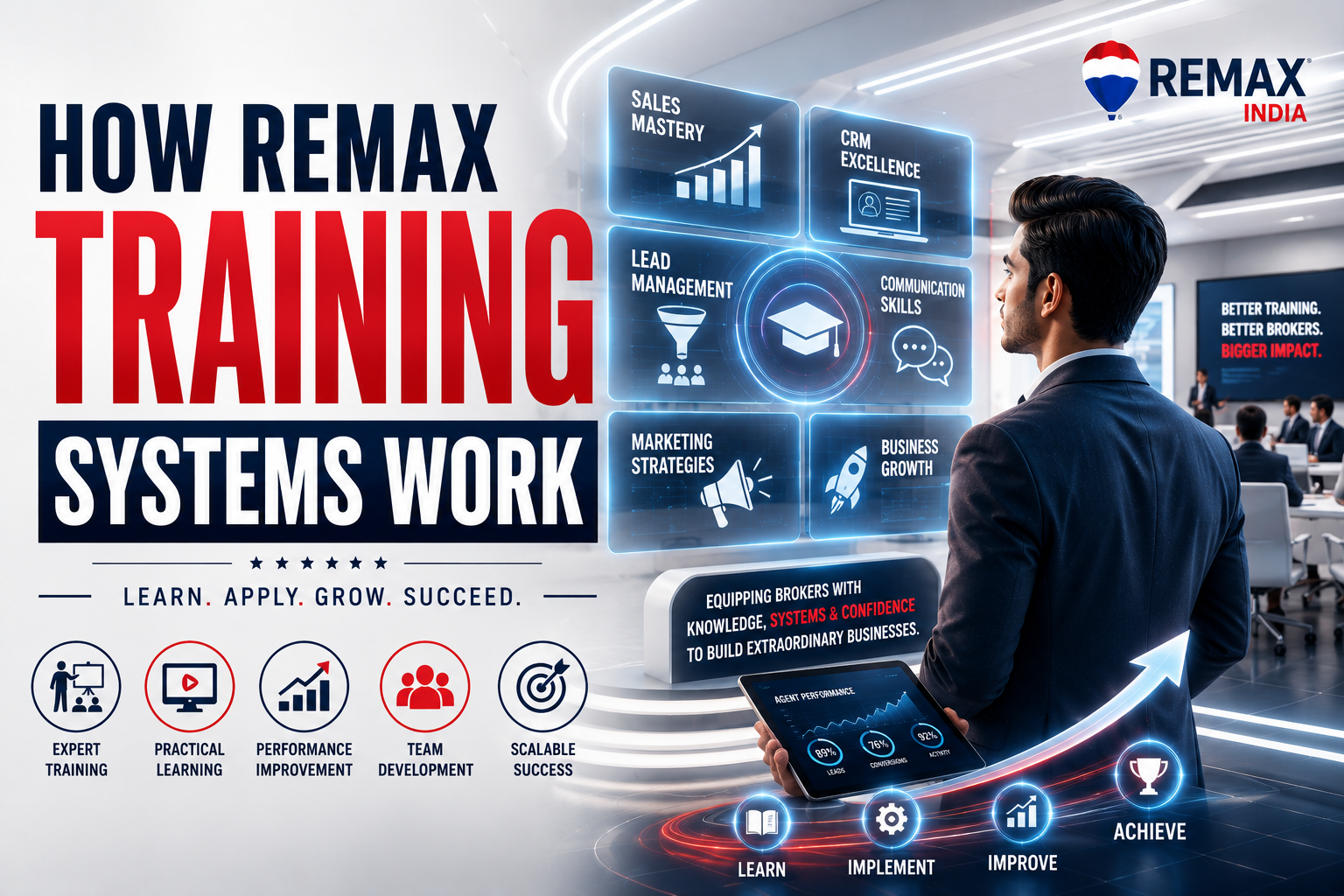
- REPA Academy — what the team calls "the MBBS of Real Estate." NSDC-approved, 90-day training programme covering everything from Facebook marketing to transaction structuring, leasing, warehousing, pricing, and negotiation. Chapter-wise exams. A new person joining your team learns the entire business within 1-2 months. You don't train your agents — the system trains them for you.
- CRM, Authorisation Portal, and KAKA AI technology.
- Proprietary listing platform (downloadbrochures.com) — generates over 1 million organic impressions every quarter.
- Cross-referral network: when a client in Delhi needs property in Goa — or Dubai — they get referred through the REMAX network. A referral client carries 35-40% trust from day one because someone in the system vouched for you.
- Property events with 1,000+ developer tie-ups and 50+ Dubai builders. Dubai builders routinely offer ₹10-20 Lakh per event to hold exclusive launch events with REMAX franchises in cities like Ahmedabad, Indore, Bhopal, and Rudrapur. They bear all expenses including event marketing. You just show up and mediate.
- International events: R4 Las Vegas (15,000+ REMAX partners globally), Asia Pacific Convention (this year in Philippines), quarterly Dubai Summit study tours, and NetMax sessions where CEO Aditya Agrawal personally visits offices for scaling discussions.
Strongest for: Entrepreneurs who want global brand credibility, serious training infrastructure, and a full marketing machine. Especially strong for markets with NRI buyer potential — the international referral network is a real pipeline, not a brochure claim.
REMAX publishes detailed, data-rich market intelligence reports for cities including Noida, Mohali, Pune, and 20+ other cities.
REGrob
Background: Indian-origin franchise brand founded by IIT/IIM alumni (Vivek Raman, Co-founder). Claims to be "India's most successful real estate franchise." Runs an active blog with 30+ franchise-related posts ranking for key search terms.
Investment: ₹13.5 Lakhs (Rise tier, 3 years) to ₹40 Lakhs (Titan tier, 5 years). Their mid-tier "Elite" package is ₹18 Lakhs for 3 years with 60 leads/month and exclusive territory rights.
What you get: AI-driven CRM, IVR setup, builder tie-ups (15-50 projects depending on tier), online + offline training, WhatsApp marketing tools. Higher tiers include sub-franchise expansion rights, dedicated IVR, and digital marketing support.
Strongest for: Entrepreneurs who want a domestic brand with structured lead generation. Their tiered model gives flexibility, and the content marketing is strong.
Worth noting: No NSDC-approved academy — training is internal. No international network or NRI referral pipeline. No per-franchise dedicated marketing team (the in-house team handles campaigns centrally). No city-level market intelligence reports. At ₹13.5-40L, the pricing is comparable to — or higher than — REMAX, but for a 3-year term vs REMAX's 5-year term. India-only brand with no global credibility signal.
eXp Realty India
Background: NASDAQ-listed, US-headquartered cloud brokerage. Fully virtual model — no physical offices. Agents work remotely via their "eXp World" platform. Entered India market recently.
Investment: Zero franchise fee. 80/20 commission split with $16,000 annual cap. Revenue sharing: 3.5% of sponsored agent commissions. Agents can earn NASDAQ stock awards.
What you get: Virtual collaboration platform, stock equity incentives, global agent network. Zero physical office overhead.
Strongest for: Experienced agents or teams who already have a pipeline and want maximum commission retention with minimal overhead. The model works well in the US where agents are already trained professionals.
The India problem: No physical office means no local trust signal — and in Indian real estate culture, "aapki office kahan hai?" is literally the first question a buyer asks. No on-ground marketing team. No structured training academy (webinar-based). No property events with developer sponsorship. India traction is still weak. The model works where agents are already trained. In India, where 85-90% of the market is untrained, training IS the product — and eXp doesn't have it.
360 Edge (by 360 Realtors)
Background: Franchise arm of 360 Realtors, one of India's larger property advisory firms. Parent company claims ₹500 Crore+ revenue and 680+ Grade-A developer relationships. Claims 100+ franchise offices.
Investment: Not transparently listed on their website. Commission-sharing model with business associates.
What you get: Access to developer relationships and lead flow from the parent company's primary market pipeline.
Strongest for: Operators in cities with heavy primary market activity (new developer launches).
Concerns: Website has broken images and hasn't been updated recently. Last press coverage dates from 2022. No training academy. No named success stories published. No international network. Focused exclusively on primary market (new launches) — if your city's resale market is bigger, this is a significant gap.
Brand Comparison Table
| Feature | REMAX | REGrob | eXp Realty | 360 Edge |
|---|---|---|---|---|
| Global Presence | 112 countries | India only | 24 countries | India only |
| Years in Operation | 52+ | ~10 | ~15 (India: ~2 yrs) | ~8 |
| Stock Listing | NYSE (RMAX) | Private | NASDAQ (EXPI) | Private |
| Franchise Fee | ₹8-15L (5 years) | ₹13.5-40L (3-5 years) | Nil | Undisclosed |
| Dedicated Marketing Team per Franchise | Yes (12-person in-house + dedicated SM manager) | No (centralised) | No | Limited |
| Training Academy | REPA (NSDC-approved, 90-day, exams) | Internal online + offline | Webinar-based | None |
| Physical Office | Yes | Flexible | No (cloud) | Yes |
| International Referral Network | Active (112 countries) | None | Growing | None |
| Developer Events | 1,000+ tie-ups, 50+ Dubai builders, ₹10-20L/event sponsorship | 15-50 builder tie-ups (tier-dependent) | None | 680+ developers |
| NRI Pipeline | Strong (Dubai Summit, R4, cross-referrals) | Weak | Growing (US base) | Weak |
| Listing Platform | downloadbrochures.com (1M+ impressions/qtr) | None proprietary | None | None |
| City Market Reports | 25+ detailed reports | None | None | None |
For the full comparison with detailed scoring, see our REMAX vs REGrob vs eXp vs 360 Edge breakdown.
How to Choose the Right Real Estate Franchise
Forget brand loyalty for a moment. Here are the six questions you should ask any franchise — including ours — before signing anything.
1. What's the total cost to get operational?
Not just franchise fee. Add office rent (6 months advance), setup, working capital, marketing spend to first revenue. If the total is more than you can afford to lose, walk away. Real estate rewards consistency, not desperation. You need runway.
2. What does the training system actually look like?
This matters more than most people think. If 85-90% of Indian brokers are untrained, your competitive edge IS training. Ask specifically: Is there a structured programme? Is it government-certified? How long? What does the curriculum cover? Can you see the syllabus? Are there exams?
A franchise that says "we'll guide you" is very different from one that hands you a 90-day NSDC-certified curriculum with chapter-wise assessments. One is a vague promise. The other is an institution.
3. What marketing support do you actually get?
"We provide marketing support" can mean anything from a logo file in your inbox to a 12-person team running your campaigns across Meta, Google, and LinkedIn. Ask: Who creates my ads? Who manages my social media? Who generates leads? What's the cost per lead in my city? Can I see examples from existing franchises? Do I get a dedicated person or am I one of 50 franchises fighting for attention from one overworked executive?
4. What's the network worth?
Real estate is a network business. Bigger network, bigger net worth. How many offices does this brand have? In which cities? Is there an active referral system — and is it actually used, or is it a slide in a PowerPoint? What percentage of deals come from cross-referrals?
A brand with offices across 25+ Indian cities and 112 countries gives you reach that no independent broker can match. A buyer in Delhi looking at property in Goa — or Dubai — gets serviced through your network. That's business you'd never access on your own.
5. What's the exit?
Not every franchise conversation includes this, but it should. What happens if you want to stop? Can you sell your franchise to someone else? What's the territory lock-in? What are the renewal terms? What do you keep if you leave?
6. Does this brand solve for closing — not just leads?
This is where most people get it wrong. They think sourcing leads is the hard part. It's not. If leads were the secret, 99acres would be the richest company in India — instead, they lose ₹23 Crore every year. They have the leads. They don't have the closing infrastructure.
Closing needs three things: trust (a brand the buyer recognises), skill (proper training in negotiation, deal structuring, compliance), and process (CRM, follow-up systems, technology). Evaluate every franchise on all three — not just how many leads they promise.
Who Should Consider a Real Estate Franchise — and Who Shouldn't
Let's be blunt. This model isn't for everyone, and pretending otherwise would be dishonest.
This fits if you're:
An existing broker who's hit a ceiling. You're doing deals, but you can't scale beyond your own effort. Every site visit, every follow-up, every negotiation is you. A franchise gives you the system to build a team and earn from their activity — not just yours. The only question for you is: how to scale beyond your own effort.
A business owner from another industry. You understand operations, team management, and P&L. You don't need to know real estate — you need a system that teaches your people real estate while you run the business. About 70% of people who come to REMAX don't have a real estate background. They learn step by step.
A corporate professional ready to build something of your own. You've spent years making money for someone else's company, hitting someone else's targets, building someone else's brand. A franchise lowers your risk compared to starting cold because you're plugging into a system that already works in 112+ countries.
This doesn't fit if you're:
Looking for quick money. Real estate rewards consistency more than speed. If you expect returns in month one, you'll be disappointed and you'll quit. Most people enter real estate randomly, do a few deals, get confused, and drop out. The ones who succeed follow a structured path — learn first, earn next, stabilise, then grow.
Not willing to invest time. Buying a franchise is not buying a vending machine. You need to show up. Build the team. Attend training. Develop builder relationships. Engage with the network. The system works — but only if you work the system.
Stretching financially to make this happen. Don't borrow heavily for this. You need enough runway to operate for 6-9 months while the business gains traction. If the franchise fee alone puts you under financial pressure, this isn't the right time.
Franchise Route vs Going Solo: An Honest Look
Most people who explore franchises also consider just starting on their own. "Why pay franchise fees when I can keep 100% of everything?"
Fair question. And the honest answer is — yes, you can go solo. Some people have built excellent independent brokerages in India. But you need to understand what you're actually signing up for.
Going solo means you build the brand from zero (nobody knows "XYZ Properties"), you figure out marketing through expensive trial and error, you train your agents yourself (assuming you know how), you build or buy a CRM (₹1-3 Lakhs/year for anything decent), you have zero referral network beyond your personal phone contacts, and you compete head-to-head against branded franchises for the same clients.
Most solo operators spend 2-3 years and ₹30-50 Lakhs just getting to the point where a franchise would've put them on day one. Some survive this. Many end up as exactly what the market already has too much of — what Nishant at REMAX calls "the graveyard of local brands that either failed within 2 years or got squeezed into a 100-square-foot office because they have no system or infrastructure."
There's also the ego factor — "I want my own brand name on the door." That's a legitimate desire. But ask yourself honestly: would you rather have your name on a struggling office, or would you rather build a ₹50 Lakh+ annual business under a brand that's been operating for 52 years across 112 countries?
The franchise route trades some margin (royalties, fees) for speed, risk reduction, and infrastructure. It's not free money — it's a business decision about leverage.
For the full breakdown with actual cost comparison tables, read our Franchise vs Independent Brokerage comparison.
How to Apply for a Real Estate Franchise (Step by Step)
Ready to explore this seriously? Here's how the process works — using REMAX as the example since we can speak to our own process with full specificity.
Step 1: Fill the eligibility form. It's a quick 7-question assessment on the website. Takes 2 minutes. No commitment, no payment — it just tells us about your background, city of interest, and investment capacity. Fill the REMAX eligibility form here.
Step 2: WhatsApp + call. You get an instant WhatsApp message confirming receipt. A representative calls you within 12 hours. This isn't a hard sell — it's a mutual fit check. We ask about your goals, you ask about the model.
Step 3: Detailed briefing. A scheduled Zoom call walks you through the full REMAX model — income streams, support infrastructure, REPA Academy, marketing, events, city-specific potential. Everything covered in this guide but with numbers specific to your market.
Step 4: Application and territory. If both sides see a fit, you submit a formal application. Territory assignment depends on availability — in-demand cities fill faster, so checking early matters.
Step 5: Onboarding. Franchise agreement, office setup support, branding, REPA Academy enrolment, marketing launch. Most franchises go from signing to operational in 30-45 days.
The whole journey from first enquiry to functioning franchise typically takes 4-8 weeks, depending on your city and how quickly you move.
Frequently Asked Questions
Do I need real estate experience to start a franchise?
No. About 70% of REMAX franchise enquiries come from people without a real estate background — business owners from other industries, corporate professionals, first-time entrepreneurs. REPA Academy exists specifically for this. It's a 90-day, NSDC-approved programme covering everything from digital marketing and lead generation to transaction structuring, negotiation, leasing, and commercial real estate. Your agents go through it too. You don't have to train anyone yourself — the system handles it.
And honestly — most people who start here don't come from real estate. They learn step by step. This is not about what you know today. It's about whether you're willing to learn and stay consistent for a few months. That's the real difference.
How much can I earn? (Kitna earn hoga?)
The honest answer: it depends on your activity, your city, and your consistency. There's no point quoting a number without context — anyone who guarantees you "₹X per month from month one" is selling you a dream, not a business.
But here's what the math looks like with a real example. A REMAX office with 5 agents, each closing 2 deals per month at an average deal size of ₹80 Lakhs and 1.5% commission — that's ₹1,20,000 per deal, ₹2,40,000 per agent per month, ₹12,00,000 gross for the office monthly. After the REMAX split and expenses, the franchise owner nets approximately ₹3.5-5 Lakhs per month. That's ₹42-60 Lakhs per year from just 5 agents.
What matters more than the exact number is the structure. In a structured system, even small consistent activity starts compounding. In an unstructured setup, even effort feels random.
Is there any guarantee this will work? (Guarantee chahiye)
Let's be straight — in any business, there is no guarantee of outcome. There is only clarity of model. No franchise, no business plan, no investment can guarantee you'll make money. Anyone who says otherwise is lying.
The real question is: does this model increase your chances of success compared to doing it randomly on your own? Does plugging into a 52-year-old system with training, technology, marketing, brand, and a global network give you better odds than starting with nothing? That's the decision you're making.
How soon can I expect revenue?
Some franchise owners close their first deal within 45-60 days. But the first 3-6 months are really about building the team, learning the system, and creating a pipeline. Revenue stabilises and starts compounding once you have 5-10 active agents consistently working the market.
Can I run this alongside my current job?
For the first month or two, maybe. But this is a real business that needs your attention. Most successful franchise owners go full-time within 3 months. You need to be present — meeting agents, attending training sessions, building developer relationships. Part-time approach usually leads to part-time results.
What if my city already has a REMAX franchise?
REMAX operates on a territory model. If your preferred area is taken, adjacent territories might be available. The eligibility form is the fastest way to check — we'll tell you within 24 hours what's open in your city.
What's the contract length?
REMAX franchise agreements are for 5 years with renewal options. Worth noting: this is a significantly longer term than some competitors who offer 3-year agreements at similar or higher price points. Discuss specific exit and renewal terms during your briefing call.
The Bottom Line
India's ₹1,00,000 Crore brokerage market is going through the biggest structural shift in its history. RERA is cleaning up the industry. Buyers demand professionalism. NRIs need brands they can trust across borders. And 90% of brokers are completely unprepared for this change.
A real estate franchise in India isn't a guaranteed cheque. No business is. But it's the difference between entering this market with a 50-year-old system behind you — training, technology, marketing, brand, network, developer relationships — or entering it with nothing but enthusiasm and hoping things work out.
You can spend the next 10 years trying to build "XYZ Properties" from scratch — buying the tech, figuring out marketing, doing the PR work, hiring agencies, failing, retrying. Or you can jump-start with 50+ years of real estate experience, which puts you 10 years ahead of your local competition.
The question isn't "will organised real estate brokerage dominate India?" It will. The question is whether you'll be the one leading it in your city.
If that question sits with you, start here: Fill the REMAX eligibility form — 7 questions, 2 minutes, and you'll know within 24 hours whether your city is available.