How Real Estate Brokerage Actually Works in India (The Business Model Explained)
Ask 10 people how a real estate broker makes money in India and you'll get 10 different half-answers. "They take commission." "They charge the builder something." "They get paid when the deal happens." All vaguely correct. None actually explaining how the business model works.
This matters because thousands of people enter real estate brokerage every year without understanding the basic economics of what they're getting into. They hear someone made ₹5 Lakhs on a single deal and think, "I can do that." They can't — because they don't understand the machinery behind that one deal. The sourcing. The qualifying. The multiple site visits. The negotiation that almost fell apart. The 40 leads that went nowhere before this one converted.
This article strips the business model down to its components. How brokers actually get paid. What the different transaction types look like. Where the money comes from, where it goes, and what determines whether a broker earns ₹50,000 a month or ₹5,00,000. No jargon, no theory — just the mechanics.
What Does a Real Estate Broker Actually Do?
A broker is an intermediary. That's it. You connect a person who wants to buy, sell, or rent property with the right counterparty. You facilitate the transaction. You earn a commission for making it happen.
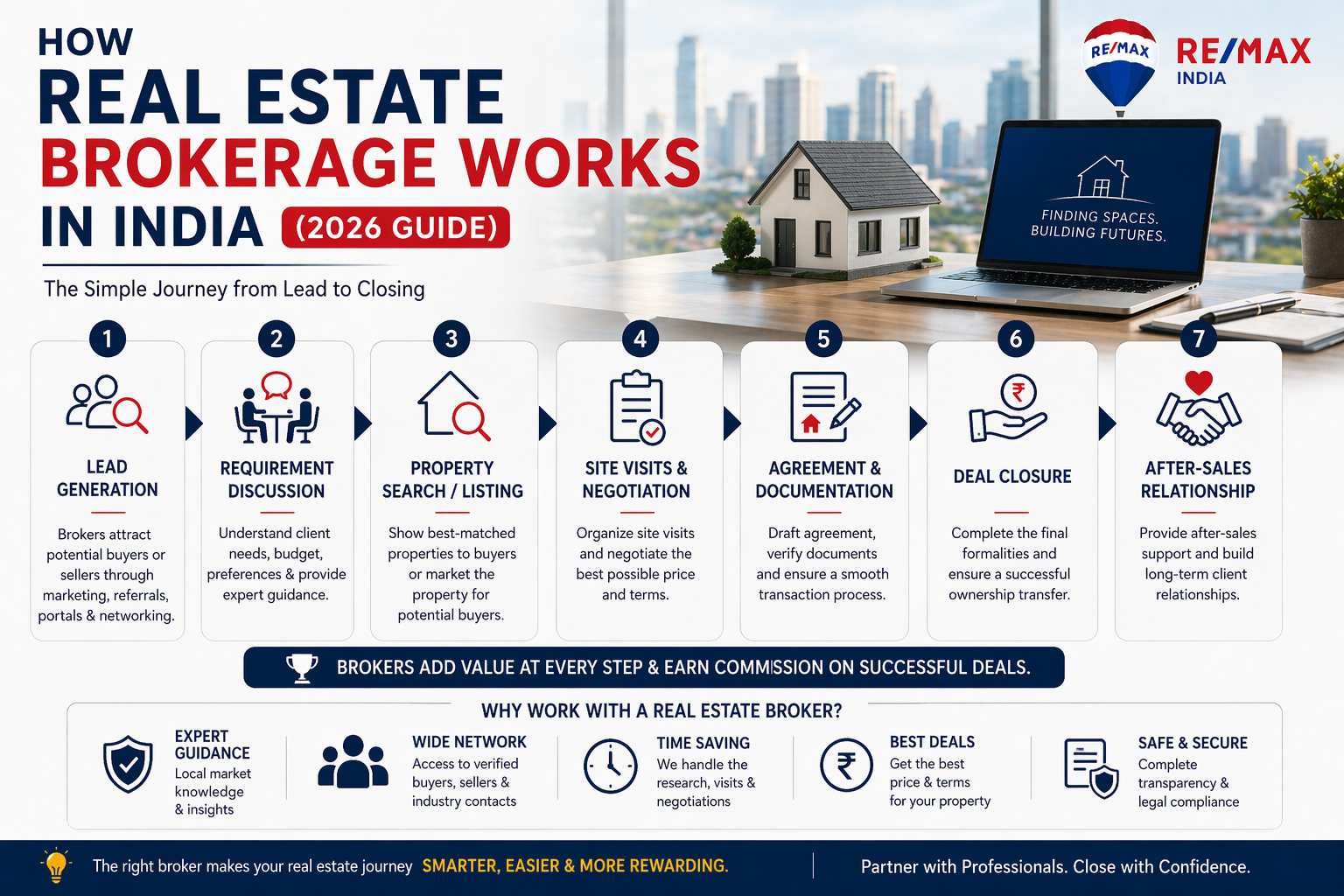
Sounds simple. In practice, it involves:
- Finding leads (buyers, sellers, tenants, landlords) through marketing, referrals, developer relationships, or walk-ins
- Understanding what the client actually needs — budget, location, property type, timeline, financing situation
- Shortlisting properties that match (or sourcing buyers for a property you've listed)
- Arranging and conducting site visits
- Negotiating price and terms between buyer and seller
- Handling documentation — agreement to sell, sale deed, builder-buyer agreement, power of attorney, loan coordination
- Supporting registration and handover
- Managing post-sale follow-ups and referral generation
Real estate has only two jobs: source the lead and close the lead. Everything above falls into one of those two buckets. The broker who is good at both — and has a system for both — makes money. The broker who stumbles through either doesn't last.
The Two Markets: Primary vs Resale
Every real estate transaction in India falls into one of two categories. Understanding which market you're operating in changes the economics completely.
Primary Market (New Projects from Builders)
A builder launches a new project — apartments, plots, villas, commercial spaces. They need sales. They don't want to hire a 50-person sales team. So they work with brokers (called "channel partners" in builder-speak) who bring buyers. You bring the buyer, the builder pays you a commission.
| Parameter | Primary Market |
|---|---|
| Who pays the broker? | The builder/developer |
| Typical commission | 1-3% of property value (sometimes higher for premium/luxury) |
| Commission on ₹80L property | ₹80,000 to ₹2,40,000 |
| Deal cycle | 2-8 weeks (shorter — builder has inventory ready) |
| Buyer source | Facebook/Google Ads, referrals, walk-ins, NRIs |
| Documentation complexity | Lower — builder handles most paperwork |
| Key skill | Lead generation + qualifying + connecting buyer to the right project |
Primary market is where most new brokers start because the builder handles a lot of the complexity — documentation, registration support, loan tie-ups. Your job is primarily bringing qualified buyers. The builder does the rest.
The catch: commission rates in primary are under pressure. Builders know that brokers compete for their projects, so commission gets negotiated down. Some builders offer 1% or even flat fees. And in primary, you're always dependent on the builder's inventory — if the project isn't good, no amount of selling skill will help.
Resale Market (Existing Properties, Owner-to-Owner)
Somebody owns a property and wants to sell it. Somebody else wants to buy in that locality. You connect them. Both sides typically pay you a commission.
| Parameter | Resale Market |
|---|---|
| Who pays the broker? | Usually both buyer and seller (1% each is common) |
| Typical commission | 1-2% from each party (total 2-4% of deal value) |
| Commission on ₹80L property | ₹1,60,000 to ₹3,20,000 (from both sides combined) |
| Deal cycle | 4-16 weeks (longer — matching buyer to specific property) |
| Buyer/seller source | Referrals, 99acres/MagicBricks, organic listings, direct outreach |
| Documentation complexity | Higher — title verification, due diligence, legal clearances |
| Key skill | Negotiation + due diligence + trust-building with both parties |
Resale is where experienced brokers make more money per deal (dual commission), but deals take longer and require deeper expertise. You need to verify the title. Check for encumbrances. Manage the buyer's loan process. Negotiate between two individuals who both think they're getting a bad deal. Handle the emotional dynamics of people selling ancestral property or buying their first home.
Resale is also where brand and trust matter most. In primary, the buyer trusts the builder. In resale, the buyer trusts you. If you're a solo broker with no brand, building that trust takes years. If you're operating under a recognised brand, the trust shortcut is built in.
Beyond Buy/Sell: Other Revenue Channels
Most people think brokerage means only buying and selling property. It doesn't. Here are the other transaction types that brokers earn from:
Rental and Leasing
Connecting tenants with landlords. Commission is typically 1-2 months' rent for residential, and varies for commercial (often a percentage of annual lease value).
Rental deals are smaller per transaction but faster to close and more frequent. A broker who builds a portfolio of rental listings creates a steady income baseline — not the ₹2 Lakh windfalls of a sale transaction, but ₹20,000-₹50,000 deals that happen every week. Smart brokers treat rentals as the foundation that pays the bills while sale transactions build the wealth.
Commercial Leasing
Office spaces, retail outlets, warehouses. Commercial leasing involves longer contracts (3-9 years typical), higher values, and more complex terms — CAM charges, escalation clauses, fit-out periods, lock-in periods. Commissions are higher per deal, but deal cycles are longer and clients are more demanding.
Samvit Shah at REMAX Ahmedabad specialises in commercial — his landmark deal was a 12,000 sqft hospital space that took a year to close. Higher complexity, but dramatically higher payout.
Developer Mandates and Project Marketing
A builder gives you an exclusive or semi-exclusive mandate to sell their project. Instead of competing with 20 other channel partners for the same project, you're the primary sales channel. The commission is typically higher (2-4%), and the relationship depth with the developer means repeat business across multiple projects.
This is a revenue stream that grows with experience and relationships. In year one, you're a channel partner. By year three, you're getting mandates. The difference in income between the two stages is significant.
Value-Added Services
Deal structuring (helping investors or developers structure transactions for tax efficiency), property management (managing rental properties on behalf of absentee owners, especially NRIs), and consulting (advising on pricing, market entry, portfolio building). These are higher-margin services that require expertise — but once you have that expertise, they become the most profitable line.
The Commission Map: Who Pays How Much for What
| Transaction Type | Who Pays | Typical Commission | Deal Size Range | Broker Earning per Deal |
|---|---|---|---|---|
| Primary Sale (Builder Project) | Builder | 1-3% | ₹30L-₹3Cr | ₹30,000-₹9,00,000 |
| Resale | Buyer + Seller (1% each) | 2% total | ₹30L-₹3Cr | ₹60,000-₹6,00,000 |
| Residential Rental | Tenant or Landlord | 1-2 months rent | ₹15K-₹1L/month rent | ₹15,000-₹2,00,000 |
| Commercial Lease | Tenant or Landlord | 1-3 months rent equivalent | ₹50K-₹10L/month rent | ₹50,000-₹30,00,000 |
| Developer Mandate | Builder | 2-4% | ₹50L-₹5Cr per unit | ₹1,00,000-₹20,00,000 |
The range is wide because real estate is local. A broker in Bhopal working ₹40 Lakh deals earns very differently from a broker in South Mumbai working ₹4 Crore deals. But the model is the same — commission as a percentage of transaction value.
Notice something: the commission percentages aren't huge. 1-3% sounds modest. But 1% of ₹1 Crore is ₹1,00,000 — for a single transaction. Do 3-4 of those a month with a small team, and you're looking at ₹3-4 Lakhs monthly. The business isn't about high margins on one deal. It's about volume through a system.
How Money Flows in a Brokerage Office
Understanding commission per deal is only half the picture. Here's how money actually flows through a brokerage operation — whether you run it solo or as a franchise.
Solo Broker Model
You do everything yourself. Source the lead. Show the property. Negotiate. Close. Collect the full commission. Sounds ideal — 100% goes to you.
Except you're limited by your own time. One person can realistically manage 10-15 active clients and close 2-4 deals per month at best. At ₹1 Lakh average commission per deal, that's ₹2-4 Lakhs/month. After office costs, marketing spend, listing fees, and phone bills — you're netting ₹1-3 Lakhs. Not bad. But the ceiling is your personal bandwidth. You can't scale without adding people.
Brokerage Office Model (Multiple Agents)
You hire agents. Each agent sources and closes their own deals. You provide the infrastructure — office, brand, CRM, marketing, training. The agent keeps the majority of their commission. You earn a share (14-34% depending on the arrangement) plus monthly desk fees (₹3,000-6,000 per agent).
This is where the economics change fundamentally. You're no longer trading your personal time for commission. You're building a platform that earns from the collective activity of multiple people.
| Metric | Solo Broker | Office with 5 Agents | Office with 10 Agents |
|---|---|---|---|
| Deals per Month | 2-4 (you do everything) | 10-15 (agents do the deals) | 20-30 |
| Your Commission per Deal | ₹1,00,000 (100%) | ₹25,000-₹34,000 (25% share) | ₹25,000-₹34,000 |
| Desk Fee Income | ₹0 | ₹25,000/month | ₹50,000/month |
| Monthly Gross Revenue | ₹2-4 Lakhs | ₹3-5 Lakhs | ₹6-10 Lakhs |
| Your Involvement | 100% — every deal is you | 40% — you manage, agents execute | 20% — system runs, you steer |
| Income Ceiling | Fixed (your hours) | Growing (add agents) | Scalable (without scaling cost) |
The shift from "I do deals" to "my team does deals" is the single most important economic decision in a real estate brokerage career. It's the difference between having a job (you trade time for money) and owning a business (the system generates income).
Why 90% of Brokers Still Struggle Despite This Model
If the model is this straightforward — source leads, close deals, earn commission, scale with agents — why are 90% of India's estimated 5-9 Lakh brokers still operating at subsistence level from 100-square-foot offices?
Because understanding the model and having the infrastructure to execute it are completely different things.
Problem 1: No Lead Generation System
Most brokers depend on referrals and walk-ins. When referrals dry up, income stops. They don't know how to run Facebook Ads (80% of real estate lead generation in India happens on Meta). They can't afford a marketing agency. They don't have a listing platform generating organic traffic. So they wait for the phone to ring — and some months, it doesn't.
Problem 2: No Training = No Closing Skill
If leads were the secret, 99acres would be the richest company in India. Instead, they lose ₹23 Crore every year. They have the leads. They don't have the closing infrastructure. Neither do most brokers. They don't know how to qualify a lead properly. They don't know how to present a property comparison. They don't know negotiation techniques. They fumble documentation. They lose deals because they don't know how to handle a buyer's objection about location or builder reputation.
Problem 3: No Brand = No Trust
A buyer spending ₹80 Lakhs on a property needs to trust the person facilitating the deal. "Sharma Properties" — with no website, no RERA registration, no office beyond a desk in someone's living room — doesn't inspire that trust. The buyer either goes directly to the builder (primary) or uses NoBroker (resale) to avoid the broker entirely.
Problem 4: No CRM = Lost Revenue
A lead calls. The broker takes the number on WhatsApp. Sends 10 property photos. Doesn't hear back. Forgets about the lead. Three months later, that lead buys from someone else. This happens hundreds of times a year in a single broker's practice — invisible revenue loss because there's no follow-up system, no pipeline tracking, no automated reminders.
Problem 5: No Agent System = No Scale
The broker tries to hire agents. The agents have no training, no leads, no brand to present. They struggle. They leave within 6 months — 69% of new real estate entrants quit in that timeframe. The broker is back to square one, still doing everything alone.
Each of these problems is a system problem, not a skill problem. The broker isn't stupid. They just don't have the infrastructure. Building that infrastructure from scratch takes years and lakhs. Or — you plug into one that already exists.
What a Structured Franchise Systematises
A franchise doesn't change the business model. The model is the same: source leads, close deals, earn commission, scale with agents. What the franchise changes is the infrastructure behind each step.
| Brokerage Function | Solo Broker | Franchise (REMAX Example) |
|---|---|---|
| Lead Generation | Referrals + hope | 12-person marketing team, Meta/Google/LinkedIn campaigns, listing platform (1M+ impressions/qtr) |
| Closing Skill | Learn by failing | REPA Academy — NSDC-approved, 90-day programme, chapter-wise exams |
| Brand Trust | Build from zero (3-5 years) | 52-year global brand, NYSE-listed, 112 countries |
| CRM & Follow-up | WhatsApp + notebook | CRM + KAKA AI + Authorisation Portal — zero leads lost |
| Agent Training | You figure it out | REPA trains them — you don't have to |
| Developer Access | Cold-call builders for years | 1,000+ developer tie-ups from day one |
| Referral Network | Your phone contacts | 25+ Indian cities, 112 countries, 35-40% trust on referral |
| NRI Pipeline | Non-existent | Dubai Summit, R4, cross-referral exchange |
The business model doesn't change. The probability of success does.
This is what separates the 10% of organised brokers who earn consistently from the 90% who struggle. Not talent. Not luck. Not market conditions. Infrastructure.
Frequently Asked Questions
Do I need a license to become a real estate broker in India?
India doesn't have a national broker licensing system like the US. However, RERA mandates that brokers register with their state Real Estate Regulatory Authority to facilitate transactions in RERA-registered projects. Registration is valid for 5 years and costs vary by state (₹10,000-₹50,000). Non-registered agents increasingly face fines and legal restrictions. A franchise handles RERA registration as part of the onboarding process.
How much can a real estate broker earn in the first year?
Depends entirely on the model. A solo unorganised broker typically earns ₹50,000-₹1,50,000/month — inconsistently, with feast-or-famine months. A franchise-backed broker with trained agents and marketing support can reach ₹2-4 Lakhs/month by month 6-12. The difference isn't ability — it's infrastructure. For detailed income math, read our franchise cost and ROI analysis.
Is real estate brokerage a full-time business?
If you want consistent income, yes. Part-time brokering generates part-time results. Clients need response within hours, not days. Site visits happen on weekday mornings. Developer meetings are during business hours. Agent management requires daily attention. You can start exploring while employed, but within 2-3 months, this needs full-time commitment to produce real results.
What's the biggest risk in real estate brokerage?
Inconsistency. Unlike a salaried job, nobody pays you for showing up. You earn only when deals close. And deals are lumpy — a great month followed by two dry months is common, especially for solo brokers. The way to manage this risk is building a pipeline (so you always have deals in progress), diversifying across transaction types (sales + rentals + commercial), and having enough agents that individual deal variability gets smoothed out across the team.
The Bottom Line
Real estate brokerage in India is a ₹1,00,000 Crore industry with a simple business model: connect buyers and sellers, earn commission. Primary sales, resale, rentals, commercial leasing, developer mandates — there are multiple ways to earn, and the commission per transaction ranges from ₹15,000 to ₹30,00,000 depending on the deal type and market.
The model works. The question is whether you have the infrastructure to execute it consistently — the lead generation, the training, the brand, the CRM, the agent system, the developer relationships, the referral network. Without these, you're in the 90% who struggle. With them, you're in the 10% who earn.
Building that infrastructure from scratch takes 3 years and ₹50 Lakhs. Plugging into a franchise that's already built it takes ₹8-15 Lakhs and 30-45 days.
That's not a pitch. That's arithmetic.
If the arithmetic makes sense for your situation: Fill the REMAX eligibility form — 7 questions, 2 minutes, territory availability confirmed within 24 hours.
For the complete franchise overview, read our Real Estate Franchise in India: Complete Guide. For how non-real-estate professionals enter the industry, see How to Start a Real Estate Business Without Experience.