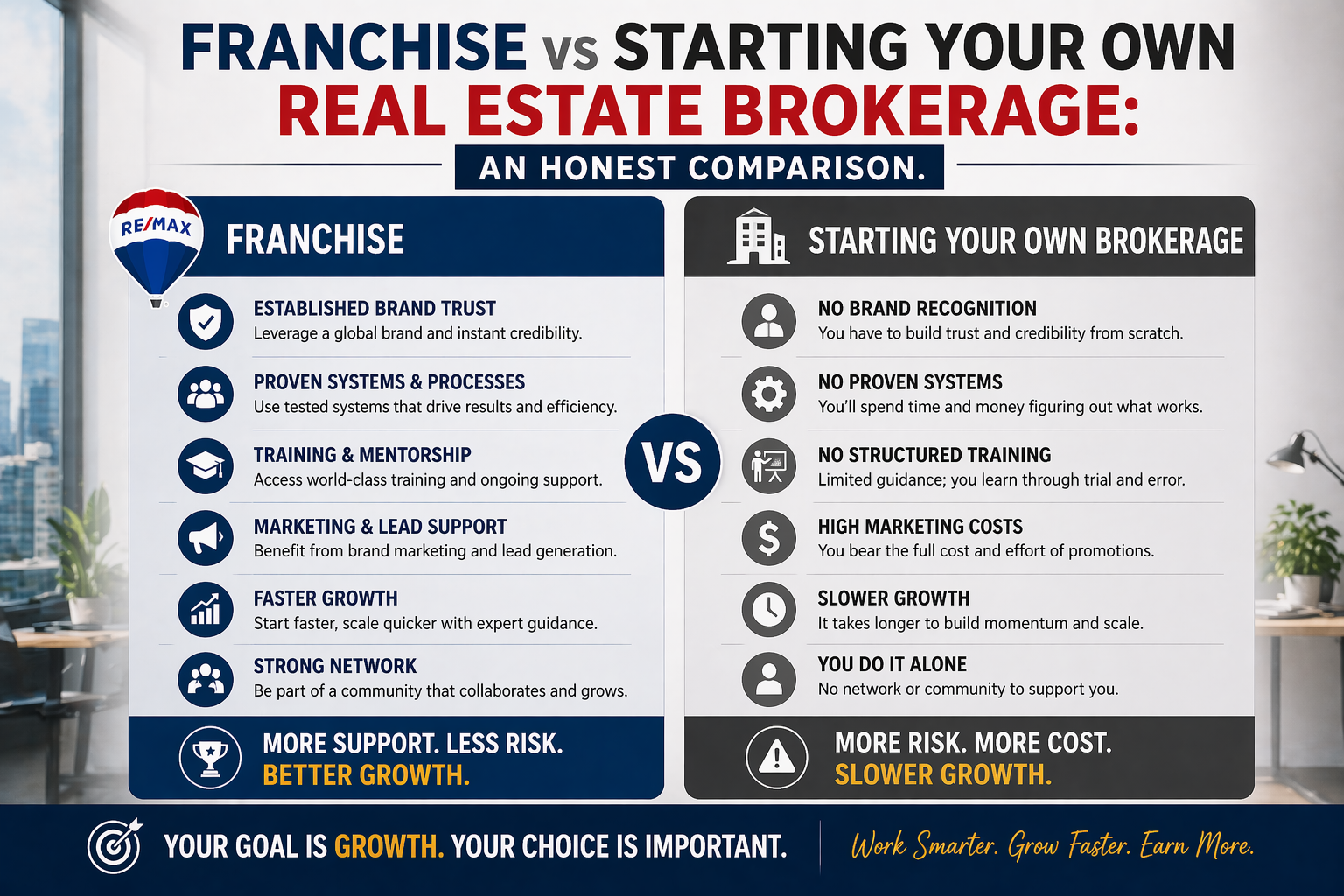
Franchise vs Starting Your Own Real Estate Brokerage: An Honest Comparison
Here's the question nobody in the franchise industry wants to address honestly: why should you pay someone else for permission to run your own business?
It's a fair question. Maybe the fairest question in this entire conversation. You're smart. You're driven. You've either run a business before or managed teams in your corporate career. Why not just start "Your Name Properties" and keep 100% of everything?
This article won't dodge that question. We're going to put the franchise route and the solo route next to each other — real costs, real timelines, real trade-offs — and let you decide. We'll also address the ego factor head-on, because that's where most of this decision actually gets made, even if nobody admits it.
Full transparency: we're REMAX. We obviously believe the franchise model works. But this article will also tell you when going solo genuinely makes more sense — because if the franchise model doesn't fit your situation, we'd rather you know that now than learn it after signing.
The Cost Comparison: Year by Year
Everyone focuses on the franchise fee. "₹8-15 Lakhs just for a brand name? I can build my own brand for free!" Sure. Let's see what "free" actually costs.
Year 1: The Setup Year
| Cost Component | Starting Solo | REMAX Franchise |
|---|---|---|
| Brand & Identity (logo, website, collateral) | ₹2-5 Lakhs | Included |
| CRM & Technology | ₹1-3 Lakhs/year | Included (CRM, KAKA AI, Authorisation Portal) |
| Marketing Agency or Team | ₹3-6 Lakhs/year | Included (12-person in-house team) |
| Social Media Management | ₹1-2 Lakhs/year | Included (dedicated manager per franchise) |
| Training Programme for Agents | ₹0 (you wing it) | Included (REPA Academy, NSDC-approved, 90 days) |
| Listing Platform Subscriptions | ₹50K-1L/year (99acres, MagicBricks) | Included (downloadbrochures.com, 1M+ impressions/qtr) |
| Developer Relationships | ₹0 in cash, 1-3 years in time | 1,000+ tie-ups + 50+ Dubai builders from day one |
| Referral Network | Your personal contacts | 112 countries, 9,200+ offices |
| Franchise Fee | ₹0 | ₹8-15 Lakhs (5 years) |
| Office Rent & Setup | ₹3-8 Lakhs | ₹3-8 Lakhs |
| Working Capital (6 months) | ₹2-5 Lakhs | ₹2-5 Lakhs |
| Year 1 Total Spend | ₹13-30 Lakhs | ₹13-30 Lakhs |
Stare at that bottom line. The Year 1 cost is virtually identical.
Going solo doesn't save you money — it just redirects where the money goes. Instead of paying a franchise fee, you're paying branding agencies, marketing agencies, CRM vendors, listing platforms, and — most expensively — you're paying in time. Time figuring out what works. Time training agents you're not qualified to train. Time building developer relationships from scratch. Time learning through mistakes that cost ₹50,000 each.
Year 2-3: Where the Paths Diverge
| Parameter | Solo Brokerage (Year 2-3) | REMAX Franchise (Year 2-3) |
|---|---|---|
| Brand Recognition in Your City | Still minimal — nobody knows "XYZ Properties" | Established — clients walk in because of the brand |
| Agent Retention | High churn — agents leave for lack of training and income | Lower churn — REPA training + system = agent income + confidence |
| Marketing Effectiveness | Still experimenting — some channels work, most don't | Optimised — 12-person team running proven campaigns |
| Developer Relationships | 3-5 developers who take your calls | 1,000+ tie-ups via network + growing local relationships |
| NRI Business | Zero — no brand recognition, no international presence | Active — cross-referrals from 112 countries + Dubai events |
| Ongoing Annual Cost | ₹8-15 Lakhs (agency fees, CRM, listings, marketing) | ~₹3-5 Lakhs (6% royalty on commission + agent fees — all else included) |
| Revenue Trajectory | Growing, but inconsistent — no system compounding | Compounding — each agent addition multiplies revenue without proportional cost |
By Year 2-3, the franchise is actually cheaper to operate than the solo brokerage. The franchise fee is a one-time cost already absorbed. The ongoing royalty (6% of commission) is proportional to revenue — you only pay it when you earn. Meanwhile, the solo operator is still paying annual agency retainers, CRM subscriptions, and listing platform fees regardless of revenue.
And the qualitative gap is even wider. A 3-year-old franchise has brand recognition, trained agents, active developer relationships, NRI referrals, and system-driven deal flow. A 3-year-old solo brokerage has... survived. Maybe. If the founder is exceptionally persistent and lucky.
Year 5: The Full Picture
| 5-Year Total Cost | Solo Brokerage | REMAX Franchise |
|---|---|---|
| Brand, Marketing, Tech, Training (cumulative) | ₹35-70 Lakhs | ₹8-15 Lakhs (one-time franchise fee) |
| Royalty (6% of commission over 5 years) | ₹0 | ₹5-15 Lakhs (depends on revenue) |
| Office & Operating Costs | ₹15-25 Lakhs | ₹15-25 Lakhs |
| 5-Year Total | ₹50-95 Lakhs | ₹28-55 Lakhs |
Over 5 years, the solo route costs roughly 1.5x to 2x more than the franchise route — and produces less in return because the solo operator spent the first 2-3 years building infrastructure that the franchise provided from day one.
This is what Nishant at REMAX means when he says: "Most people spend 3 years and ₹50 Lakhs just to learn the lessons REMAX already solved in the 1970s." It's not a tagline. It's arithmetic.
The Timeline Comparison: When Does Money Start Flowing?
| Milestone | Solo Brokerage | REMAX Franchise |
|---|---|---|
| Office operational | Month 2-3 | Month 1-2 (30-45 days from signing) |
| First deal closed | Month 4-8 (if lucky) | Month 2-3 (45-60 days typical) |
| 5 agents hired and active | Month 6-12 | Month 3-6 |
| Consistent monthly income | Month 18-36 | Month 6-12 |
| 10+ agents, scaled operation | Year 3-5 (if you survive) | Year 1-2 |
| NRI business pipeline active | Likely never (no brand, no network) | Year 1 (cross-referral system + events) |
The franchise doesn't just save money. It saves time. And in business, time is the most expensive resource — because every month you spend "figuring things out" is a month your revenue is zero while your costs are very much not zero.
Consistent monthly income at month 6-12 vs month 18-36. That's a 12-24 month head start. At ₹2 Lakhs/month net income (conservative franchise estimate), that head start is worth ₹24-48 Lakhs in revenue you earn that the solo operator doesn't. The franchise fee paid for itself three times over — in revenue generated, not just costs avoided.
The Ego Question: "I Want My Own Brand Name"
Let's address the elephant. Because for a lot of people, this decision isn't actually about money or timelines. It's about identity.
"I want my name on the door. I want to build MY brand. I don't want to operate under someone else's rules. I want 100% control."
These are legitimate desires. Nobody should pretend they're not. The aspiration to build something that carries your name is powerful, and it drives people to do extraordinary things.
But let's separate ego from economics for a moment.
Your name on a failing business isn't a source of pride. If "Kapoor Properties" shuts down in 18 months because you ran out of working capital, didn't have trained agents, couldn't generate consistent leads, and had no brand recognition to attract clients — your name is associated with a failure, not a brand. The graveyard of local real estate brands across India is full of proud names that nobody remembers.
Your name on a successful franchise IS a source of pride. Sumanth Gopinath runs REMAX Heritage Properties in Mysuru. After 13 years, locals call him "REMAX Sumanth." His name and the brand have become inseparable in that city. Anurag Saxena IS REMAX Prime Properties in Bhopal — 15 years of his reputation built on top of the brand's foundation. They didn't lose their identity. They amplified it.
Would you rather own 100% of a ₹5 Lakh/year business or a share of a ₹50 Lakh/year business? That's the real question. "Keeping 100%" sounds great until you calculate what 100% of a struggling solo brokerage actually is. The franchise takes 6% royalty — but 94% of a much larger number is significantly more than 100% of a small one.
Now — if brand identity is genuinely more important to you than income, speed, and risk reduction — that's a valid personal choice. Not everyone is optimising for money. Some people want the creative freedom and personal satisfaction of building from scratch, even if it's harder and slower. If that's you, respect. Go build it. Just go in with eyes open about what it costs and how long it takes.
What Nishant's Story Teaches About Both Paths
Nishant, who now heads marketing at REMAX India, lived the solo brokerage reality before joining the franchise side. His story is worth revisiting because it captures both paths — and why he switched.
"Back in 2013, I entered real estate as a sales executive at a local brokerage firm in Delhi NCR. Over time, I grew, built teams, and completed ₹125 Crore+ in property transactions over five years."
That's the solo model working. He was good at his job. Made money for the company. Built a team. Hit targets. Things were rolling.
Then COVID hit.
"Even after making a hell lot of money for company directors, I got a salary cut. I lost my team because there was no money to pay their salaries. I thought about starting my own brokerage firm, but I didn't have the infrastructure or the salaries to support a 20+ person team."
This is the part that solo brokerage advocates don't think about. The local firm he worked for wasn't a fly-by-night operation. They had 20+ years of history. But when the market turned, they didn't have the infrastructure to weather it. Building a brand takes 20 years. Losing it takes one bad quarter.
"I don't blame the company. They have their own challenges — building a brand, hiring and training people, paying salaries on time. Most importantly, it took 20+ years for them to reach where they are now. But most people make the mistake of trying to build their own brand from scratch."
20 years. That's the timeline for a solo brokerage to reach what Nishant calls "stability." And even at 20 years, it wasn't enough to survive a market downturn without casualties.
A 52-year-old global franchise survived COVID. It survived multiple recessions. It survived market cycles across 112 countries. That resilience isn't theoretical — it's structural. When your brand, training, technology, and network are backed by a NYSE-listed system that's been through every possible market scenario, a single bad quarter doesn't destroy the foundation.
When Going Solo Actually Makes Sense
We said we'd be honest. So here's the honest case for starting independently:
You have 10+ years of deep local market experience. You know every builder, every locality, every pricing trend in your city. Your phone has 500+ active contacts who already trust you personally. You've closed ₹50 Crore+ in transactions. You don't need brand credibility — you ARE the brand in your micromarket. In this case, a franchise fee is buying infrastructure you've already built.
You want to build a tech-first platform, not a brokerage. If your ambition is to create the next NoBroker or Housing.com — a platform that fundamentally changes how transactions happen — a franchise model isn't the right vehicle. Franchises are about executing a proven model. Platform building is about inventing a new one.
You can genuinely afford to wait 3 years for income. If you have enough savings or other income sources to fund 3 years of zero-to-low revenue while you build from scratch — and that 3-year runway doesn't cause you financial stress or family friction — the solo path is viable. Expensive in time, but viable.
You're in a hyperlocal niche that doesn't need brand. If you specialise in something extremely specific — agricultural land transactions in one district, industrial warehousing in one corridor, ultra-luxury penthouses in one neighbourhood — a global brand might not add value. Your niche reputation is your moat.
If any of these describe you, starting solo could genuinely be the right call. But notice the common thread: each scenario requires either massive existing experience, massive financial runway, or both. For the 70% of people who enter real estate without an existing background — which is the majority — the franchise path eliminates the hardest variables from the equation.
The 10-Year Question
Zoom out from the spreadsheets and timelines. The real decision here is about the next decade of your professional life.
You can spend those 10 years trying to build "XYZ Properties" from scratch — buying the tech, learning about marketing, doing PR work, hiring agencies, failing, retrying. At the end of 10 years, you might have a viable local brokerage — or you might be another name in the graveyard of brands that didn't survive.
Or you can invest ₹8-15 Lakhs today and jump-start with 50+ years of real estate experience — training, technology, marketing, brand, network — which puts you 10 years ahead of your local competition from day one.
Both paths require hard work. Both require consistency. Both require showing up every day. The difference is what you're building ON. One path gives you a proven foundation. The other gives you a blank canvas and a very expensive set of art lessons.
Frequently Asked Questions
Can I convert my existing brokerage into a franchise later?
Yes. Many REMAX franchise owners were independent brokers first. They realised that their local expertise, combined with a franchise's brand, training, and network, would produce more than either could alone. The transition typically involves rebranding, enrolling your agents in REPA Academy, and integrating into the REMAX systems. Your existing relationships and market knowledge don't go away — they get amplified.
Will I lose autonomy as a franchise owner?
You own and operate your office. You hire your agents. You choose which developers to work with. You decide your local marketing priorities. The franchise provides the system — brand standards, training curriculum, technology platform, commission structures. You run the business within that framework. Think of it like this: a McDonald's franchise owner doesn't decide the menu, but they run their own restaurant. A REMAX franchise owner follows the brand system, but they run their own real estate business. You're a business owner, not an employee.
What happens to my brand if I leave the franchise after 5 years?
If you don't renew, you stop using the REMAX name, brand assets, and systems. Your clients, agent relationships, and market knowledge remain yours. Some franchise owners renew because the value of the brand continues to justify the royalty. Others use the 5-year term to build enough market presence and expertise that they feel confident transitioning to independence. Discuss specific exit and renewal terms during your briefing call.
Do I pay royalty even in months when I don't earn?
The 6% royalty is on gross commission earned by your office. No commission = no royalty. It's proportional to revenue, not a fixed fee. Your only fixed franchise costs are the ₹1,000/month per agent fee. This means the franchise's cost structure actually provides a cushion during slow months — unlike a marketing agency retainer or a CRM subscription that charges you the same amount whether you're closing deals or not.
I know people who built successful independent brokerages. Why can't I?
You might. Some people genuinely do. But survivorship bias is real — for every successful independent brokerage you can name, there are 50 that quietly shut down within 3 years. The ones you see are the exceptions. The ones you don't see are the rule. A franchise doesn't guarantee success either — but it dramatically improves the odds by removing the variables that kill most solo operators: no brand, no training, no marketing system, no network.
The Bottom Line
This isn't a question with one right answer. It depends on where you're starting from, what resources you have, and what you're optimising for.
If you have 10+ years of deep market experience, ₹50+ Lakhs to invest in brand-building, and 3 years of financial runway — going solo is a legitimate option. Hard, expensive, slow — but legitimate.
If you're entering real estate without an existing network, if you want income within 6-12 months instead of 24-36, if you'd rather invest ₹8-15 Lakhs in a proven system than ₹50 Lakhs in trial-and-error — the franchise route gives you a structural advantage that takes years to build independently.
The franchise fee isn't a "cost." It's the price of compressing 3 years of painful learning into 90 days of structured onboarding. It's the price of walking into your city on day one with a 52-year-old brand, a trained team, a marketing machine, and a 112-country referral network. It's the price of not becoming another name in the graveyard of local brands that couldn't survive their own learning curve.
More important than the route you choose is the honesty with which you choose it. If you're going solo because you've done the math and it works for your situation — respect. If you're going solo because your ego can't handle someone else's name on the door — that's an expensive feeling.
If the franchise route makes sense for where you are, start here: Fill the REMAX eligibility form — 7 questions, 2 minutes, territory availability confirmed within 24 hours.
For the complete franchise overview, read our Real Estate Franchise in India: Complete Guide. For cost details, see the franchise cost breakdown. For real franchise owner stories, see REMAX Success Stories.