The Unorganised Broker Problem: Why India Needs RERA-Ready Real Estate Franchises
There are an estimated 5 to 9 Lakh real estate brokers operating across India. The vast majority of them are unregistered, untrained, unbranded, and running their businesses out of a mobile phone and a notebook.
This isn't a fringe problem. It's the defining structural weakness of a market worth ₹1,00,000 Crore in brokerage revenue annually — a market that contributes roughly 11% to India's GDP. And it's a problem that's been tolerated for decades because nobody had the regulatory teeth or the market pressure to fix it.
Both of those things have changed. RERA is tightening. Buyer expectations are rising. NRI capital demands professionalism. And a company called NoBroker built a billion-dollar valuation by solving a single problem: helping people avoid dealing with unorganised brokers entirely.
When buyers are willing to pay money to NOT interact with your industry — that's not a marketing problem. That's a systemic credibility crisis.
This article examines why Indian real estate brokerage is broken at a structural level, what RERA 2.0 is doing about it, why technology alone doesn't fix it, and what the actual solution looks like. Spoiler: the answer isn't eliminating brokers. It's professionalising them.
The Numbers Behind the Problem
Let's start with the data, because the scale of disorganisation is difficult to grasp without it.
| Parameter | Current Reality |
|---|---|
| Estimated number of brokers in India | 5,00,000 to 9,00,000 |
| Percentage unorganised | ~90% |
| Annual brokerage market | ₹1,00,000 Crore (~₹18,000 Crore in direct broking fees) |
| Real estate contribution to GDP | ~11% (~₹11 Lakh Crore) |
| Broker RERA registration compliance | Low — majority unregistered |
| Average broker training | Zero formal training |
| Attrition rate for new entrants | 69% quit within 6 months |
Read the attrition number again. 69% of people who enter real estate brokerage in India leave within six months. That stat comes from Anurag Saxena, a 15-year REMAX franchise owner in Bhopal who's watched this pattern repeat across market cycles. People hear there's money in real estate. They try something. They flounder. They can't cover their monthly expenses. They quit.
The industry doesn't just have a quality problem. It has a survival problem. The churn is so high that the market keeps replenishing itself with beginners who repeat the same mistakes as the last batch of beginners — creating an endless cycle of untrained, unbranded, unsystematic brokers serving a ₹1 Lakh Crore market.
What "Unorganised" Actually Looks Like on the Ground
The word "unorganised" gets thrown around in every real estate article. But what does it actually mean when a buyer interacts with the 90%?
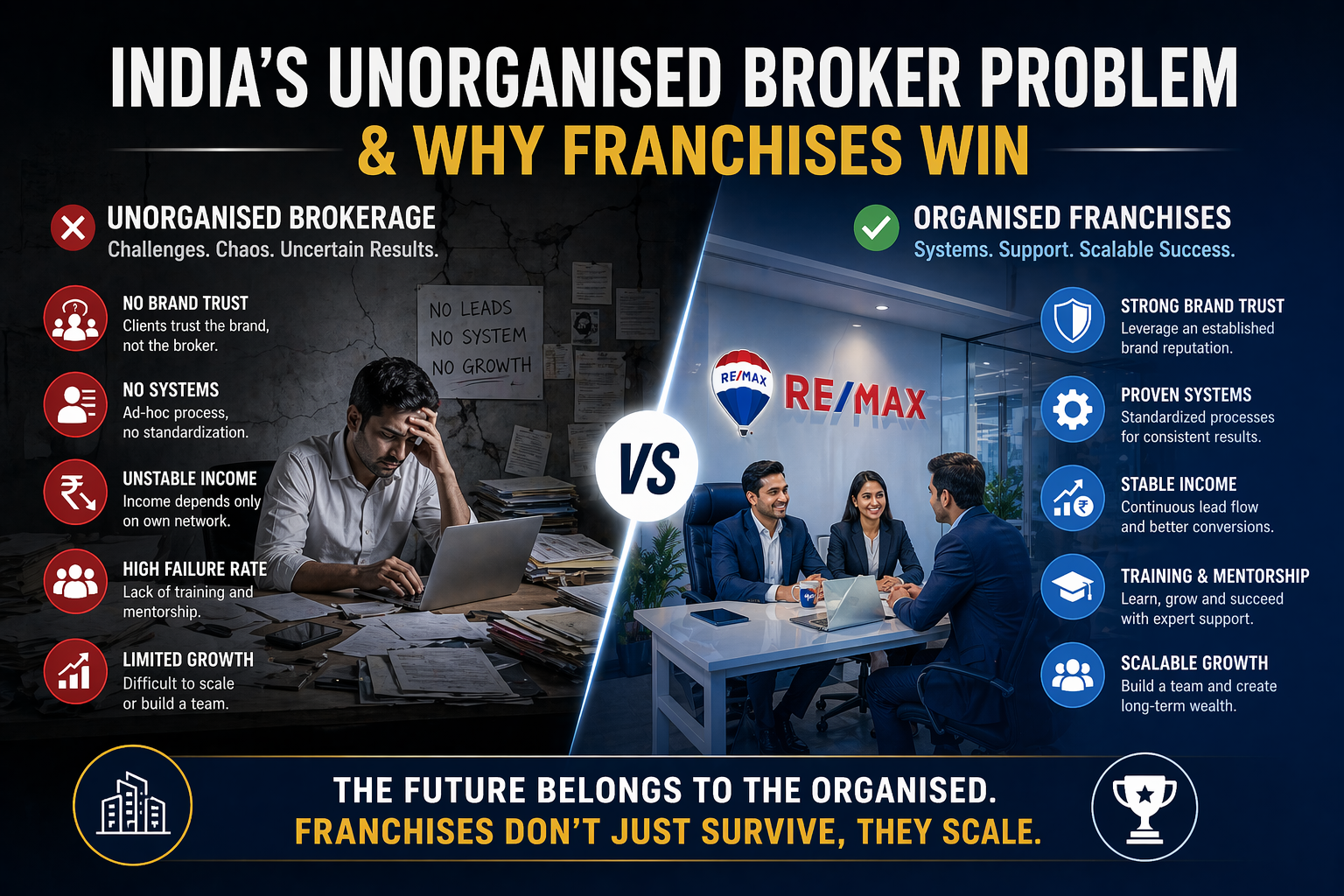
No CRM, no follow-up system. The broker takes your phone number, sends you 15 WhatsApp photos of random properties (half of which don't match your requirements), and if you don't respond in 48 hours, you're forgotten. Not because they don't care — because they have no system to track leads. They're managing 50 enquiries in their head and 200 in a notebook. Leads don't fall through the cracks — they fall into a black hole.
No training. The average Indian broker has never taken a course in property law, transaction documentation, negotiation, marketing, RERA compliance, or even basic customer service. They learned by watching someone else fumble through a few deals. The "training" is osmosis from other untrained brokers — garbage in, garbage out, across generations.
No brand. "Sharma Real Estate." "Kumar Properties." "XYZ Realty Solutions." These names mean nothing to a buyer. There's no accountability behind them. No national or international recognition. No website beyond a basic WordPress page with stock photos. If something goes wrong after the deal, the buyer has no one to complain to — because the "brand" is one person with a board outside a 100-square-foot office.
No transparency on commission. Is it 1%? 2%? From buyer, seller, or both? Is the broker also taking money from the builder and not disclosing it? In the unorganised market, commission structures are opaque, negotiated ad-hoc, and frequently involve undisclosed dual brokerage. The buyer rarely knows what they're actually paying for.
No post-transaction relationship. The broker's phone becomes magically unreachable after the commission clears. Need help with registration issues? Good luck. Rental management for your investment property? Not their problem. Warranty claims against the builder? You're on your own. The relationship begins and ends with the commission cheque.
This is what 90% of a ₹1 Lakh Crore market looks like. Not in 1990. In 2026.
The NoBroker Proof: Buyers Will Pay to Avoid You
If you want to understand how deep the trust deficit runs, look at NoBroker.
NoBroker built a billion-dollar valuation on a single value proposition: eliminating the broker from the transaction entirely. Their pitch to buyers was essentially "pay us a platform fee, and you'll never have to deal with a broker." Millions of Indians said yes.
Think about what that means. Buyers aren't just unhappy with broker service — they're unhappy enough to pay for an alternative that removes brokers from the equation altogether. In any other industry, if your customers are paying money specifically to avoid interacting with you, you'd call it an existential crisis. In Indian real estate brokerage, it barely registered as a wake-up call.
But here's what NoBroker's success actually proved — and what most people miss: buyers don't hate brokers. They hate bad brokers. They hate untrained, unaccountable, opaque, unprofessional service. Give them a broker who is trained, branded, transparent, and accountable, and they'll happily pay full commission. NRIs already do this — they willingly pay 1-2% commission to professional brokerages because trust is worth paying for when you're buying from 8,000 km away.
The solution isn't removing brokers. Complex real estate transactions — commercial deals, multi-crore residential purchases, cross-city investments — genuinely need a human intermediary. Someone who knows the local market. Someone who can negotiate with builders. Someone who handles documentation. The solution is making that intermediary professional.
RERA 2.0: The Regulatory Hammer Is Coming
RERA (Real Estate Regulation and Development Act) was passed in 2016 with good intentions. It mandated broker registration, ethical transaction practices, and penalties for non-compliance. In theory, it should have professionalised the brokerage market overnight.
In practice, enforcement has been slow and uneven. Most states now have active RERA authorities, but broker registration compliance remains low. The majority of India's 5-9 Lakh brokers continue to operate without RERA registration — either because they don't know about it, don't think it's enforced, or deliberately avoid it.
That's changing. RERA 2.0 — the term used for the strengthened enforcement happening in 2026 — is bringing real consequences:
- Non-registered agents can face fines and legal action
- Only RERA-registered brokers can legally facilitate transactions in RERA-registered projects
- Mandatory RERA numbers must appear in all advertisements, brochures, and websites
- Digital marketing campaigns are being monitored for compliance
- Buyers are increasingly checking agent registration status on state RERA portals before engaging
The regulatory direction is clear: unregistered, unaccountable brokers will be progressively squeezed out of the market. Not tomorrow — but inevitably. Every year, enforcement tightens. Every year, buyer awareness grows. Every year, the cost of being unorganised goes up.
For brokers who are already RERA-registered, trained, and operating under a recognised brand — this isn't a threat. It's a competitive moat that gets deeper every year.
Why Technology Alone Doesn't Fix This
Every few years, a new prop-tech startup promises to "disrupt" Indian real estate brokerage. Platforms, apps, AI-powered matching, virtual tours, automated valuations. Hundreds of crores of VC money poured in.
And yet — 90% of the market is still unorganised. Why?
Because technology doesn't solve a people problem. Real estate transactions in India involve emotional buyers, complex legal documentation, non-standardised pricing, builder relationships built over years, local market nuance that no algorithm captures, and negotiation dynamics that require a human sitting across the table.
If leads were the secret, 99acres would be the richest company in India. Instead, they lose ₹23 Crore every year. They have the leads. They have the technology. What they don't have is the closing infrastructure — the trained human being who converts a lead into a transaction.
Real estate has only two jobs: source the lead and close the lead. Technology can help with sourcing. But closing requires trust (brand), skill (training), and process (systems). No app provides these. A structured franchise does.
What the Solution Actually Looks Like
If the problem is unorganised brokers, the solution is organised brokers. Not fewer brokers — better brokers. Specifically, brokers who have four things the current market lacks:
1. Brand Accountability
When a broker operates under a recognised brand, the brand itself creates accountability. A buyer who has a bad experience with "REMAX Heritage Properties, Mysuru" can escalate to REMAX India. There's a parent organisation. There's a reputation to protect. There's a system for handling complaints. Compare that with "Sharma Real Estate" — if things go wrong, your only recourse is calling the same mobile number that's already stopped picking up.
A brand also creates a trust shortcut. A buyer walking into a REMAX office (52+ years, NYSE-listed, 112 countries, 9,200+ offices globally) doesn't need to spend 3 meetings evaluating whether this broker is legitimate. The brand has already answered that question. In an industry where trust is the bottleneck, a brand is the fastest solution.
2. Structured Training
The most fundamental fix the market needs is training. Not motivational webinars. Not YouTube playlists. A structured, certified, curriculum-based training programme with assessments.
REMAX's REPA Academy is NSDC-approved — certified by the National Skill Development Corporation. 90 days. Covers Facebook and Google marketing, lead management, residential transactions, commercial leasing, warehousing, pricing strategy, negotiation, and RERA compliance. Chapter-wise exams. A complete beginner walks in and comes out a functional professional in 60-90 days.
The team calls it "the MBBS of Real Estate." And the analogy holds — you wouldn't let someone practice medicine without medical school. Why do we let people handle ₹50 Lakh-₹5 Crore transactions without any training at all?
When agents are trained, the 69% attrition rate drops. They know what to do. They have confidence. They have a system to follow. They produce results early enough that they don't need to quit at month six. Training doesn't just improve quality — it improves survival.
3. Technology Systems (Not Technology for Its Own Sake)
The problem isn't that brokers don't have apps. The problem is that they don't have CRM systems that track every lead, follow-up systems that ensure no prospect falls through the cracks, listing platforms that generate organic leads, and authorisation portals that manage compliance documentation.
REMAX provides all of this: CRM, Authorisation Portal, KAKA AI, and a proprietary listing platform (downloadbrochures.com) generating 1 million+ quarterly organic impressions. Technology as infrastructure — built into the workflow, not bolted on as an afterthought.
4. Network Effects
An individual broker's reach is limited to their personal phone contacts. A franchise network's reach compounds with every office added. REMAX operates across 25+ Indian states and 112 countries. A buyer in Delhi looking at property in Goa gets referred through the network. An NRI in Dubai wanting to invest in Ahmedabad gets connected through the cross-referral exchange. A referred client carries 35-40% trust from day one because someone in the system vouched for you.
In real estate, the bigger your network, the bigger your net worth. An organised franchise creates network effects that no individual broker — however talented — can replicate.
The Consolidation Is Already Happening
This isn't a theoretical prediction. The shift from unorganised to organised is already underway across Indian industries — and real estate is next.
Retail went from kirana stores to Reliance Fresh, DMart, and BigBazaar. Not all kiranas died — but the organised players captured disproportionate market share. Hospitality went from independent lodges to OYO, Marriott, and Taj. The independents still exist, but branded chains dominate the premium and mid-market segments.
Indian real estate brokerage is at the same inflection point. The triggers are identical: regulatory pressure (RERA), changing consumer expectations (NRIs, digitally-savvy buyers), technology adoption requirements (CRM, digital marketing), and market entrants bringing organised models (franchise brands).
The question is not whether organised brokerage will dominate India. It will. The question is who will be leading it — and who will be watching from the graveyard of local brands that either failed within 2 years or got squeezed into a 100-square-foot office because they had no system and no infrastructure.
What This Means If You're Considering Entering the Market
If you're reading this as someone exploring the real estate brokerage business — whether you come from real estate or not — here's the strategic picture.
You're looking at a ₹1,00,000 Crore market where 90% of the operators are structurally uncompetitive. RERA is tightening regulatory requirements. Buyer expectations are rising every year. NRI capital (projected at 25% of the $450 billion market by 2030) demands professional service. And the dominant technology platforms have proven that leads alone don't make a business — closing infrastructure does.
Entering this market as yet another independent "XYZ Properties" puts you in the 90% — competing against hundreds of identical operators with no differentiation, no training, no brand, and no system. That's not a business strategy. That's a coin flip.
Entering this market with a structured franchise — brand, training, technology, marketing, network — puts you in the 10% from day one. You're not starting from scratch. You're stepping into a system that's been refined over 52 years across 112 countries. The model is proven. The infrastructure is built. The regulatory tailwind is at your back.
Most people who start on their own spend 3 years and ₹50 Lakhs just to learn the lessons that organised franchise systems already solved decades ago. That's not a smart use of time or capital. It's just expensive education.
Frequently Asked Questions
Is RERA registration really mandatory for brokers?
Yes. Under Section 9 of the RERA Act, every agent facilitating transactions in RERA-registered projects must be registered with their state RERA authority. Registration is valid for 5 years and must be renewed. Non-registered agents face fines and legal action. Enforcement varies by state, but the trend is toward stricter compliance — especially in Maharashtra, Karnataka, Gujarat, Haryana, and Uttar Pradesh.
Can unorganised brokers simply register with RERA and become "organised"?
RERA registration is necessary but not sufficient. Registration gives you legal compliance. Being organised means having training, technology, brand, marketing systems, and process — none of which come with a RERA number. A broker who registers with RERA but still operates from a notebook with no CRM, no training, and no brand is a registered unorganised broker. The market will still bypass them for the same reasons it does today.
Will small brokers survive this shift?
Some will — particularly those with deep local relationships and hyperlocal market knowledge. But they'll face increasing pressure from organised players who offer the same local knowledge plus brand, training, technology, and network. The smartest small brokers will recognise this and join franchise systems — converting their local expertise into a structured business instead of fighting the tide alone. Many REMAX franchise agents are exactly this: experienced local brokers who realised the system multiplies their existing skills.
How long will this consolidation take?
India's retail consolidation took 15-20 years and is still ongoing. Real estate brokerage will likely follow a similar timeline. The opportunity isn't going to be fully captured in 2-3 years — which means early movers have a significant advantage. Getting established in your city territory now, while most of the market is still unorganised, means building your brand and agent team before the competition arrives.
The Bottom Line
India's real estate brokerage industry is broken. Not at the edges — at the core. 90% unorganised. Millions of buyers who distrust the very people meant to help them. An attrition rate that kills two-thirds of new entrants before they make it through six months. A regulatory framework that's finally demanding professionalism, and a massive NRI capital wave that refuses to work with anyone who can't provide it.
This isn't a problem to complain about. It's an opportunity to build on.
The professionals who enter this market now — with brand, training, technology, and systems — aren't competing against 9 Lakh brokers. They're competing against the 10% who are organised. The other 90% aren't competition. They're the market you're replacing.
The question is not whether organised brokerage will dominate India. It will. The question is whether you'll be the one leading it in your city.
Fill the REMAX eligibility form — 7 questions, 2 minutes, territory availability confirmed within 24 hours.
For the complete franchise overview, read our Real Estate Franchise in India: Complete Guide (2026). For cost details, see the franchise cost breakdown.