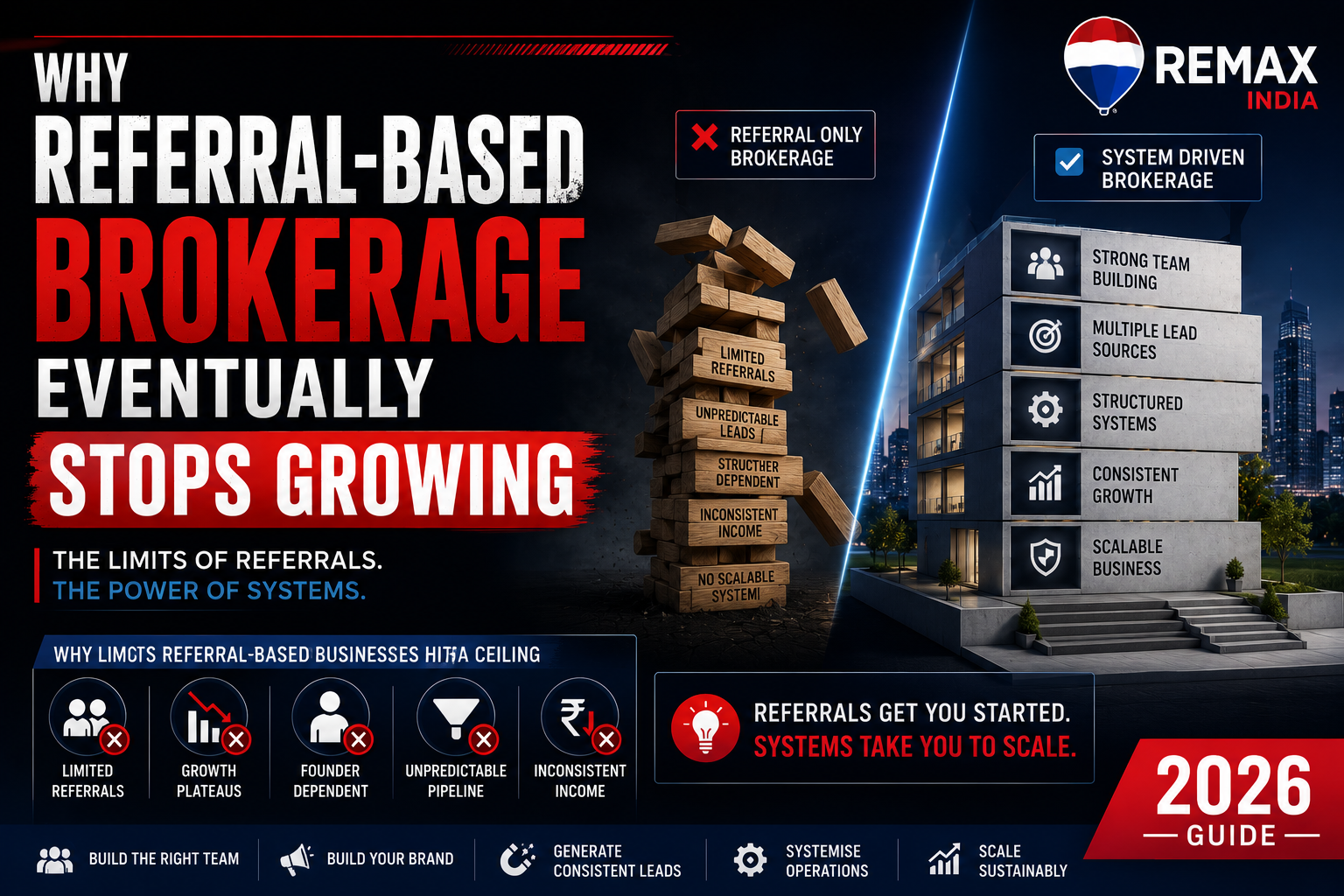
Why Referral-Based Brokerage Eventually Stops Growing
In Indian real estate, referrals are treated like the gold standard.
And honestly, referrals are powerful.
A referred client usually trusts you faster, negotiates less aggressively, and converts better compared to cold internet leads.
That’s why most brokers initially build their entire business around referrals.
One happy client brings another. One investor introduces friends. One builder contact creates more opportunities.
And for a while, the business grows smoothly.
But then something strange happens.
Growth slows down.
Revenue becomes inconsistent.
Lead flow becomes unpredictable.
And suddenly the same brokerage that once felt “busy” starts struggling to scale further.
This is the hidden limitation of referral-based brokerage models.
Referrals help businesses survive.
But referrals alone rarely help businesses scale aggressively.
Why Referrals Feel So Powerful Initially
The early stage of brokerage growth is usually relationship-driven.
Especially in India.
People trust people.
Most first deals happen because:
- someone knew the broker personally
- a friend recommended them
- a relative connected the client
- an old investor shared their number
And honestly, this works extremely well at small scale.
Referral clients generally:
- convert faster
- trust more easily
- need less convincing
- create better long-term relationships
That’s why many brokers become overconfident after initial success.
They assume:
“Bas referrals aate rahein toh business grow karta rahega.”
Unfortunately, real scaling doesn’t work that way.
The Hidden Problem With Referral-Only Brokerage
| Referral Advantage | Long-Term Limitation |
|---|---|
| Low acquisition cost | Lead volume becomes limited |
| High trust factor | Growth becomes unpredictable |
| Strong personal relationships | Founder dependency increases |
| Easy initial deals | No scalable lead system |
| Good local reputation | Weak market expansion |
| Organic growth | Growth plateaus eventually |
Most Referral Businesses Depend on One Person
This is the real issue almost nobody discusses openly.
Most referral-driven brokerages are actually founder-driven brokerages.
The business depends heavily on:
- the founder’s relationships
- the founder’s network
- the founder’s reputation
- the founder’s communication skills
Which means:
If the founder slows down… the business slows down.
That’s not scalability.
That’s dependency disguised as entrepreneurship.
Many brokers stay trapped at the same revenue level for years because their lead generation system is entirely relationship-based.
No structured marketing.
No inbound system.
No recruitment engine.
No scalable acquisition channels.
The Real Estate Market Has Changed Dramatically
Ten years ago, referral-heavy brokerage models worked better because competition was smaller and buyers had fewer choices.
Today the environment is completely different.
Clients now expect:
- fast response times
- professional presentation
- CRM follow-up
- digital inventory sharing
- market research
- brand credibility
Especially premium buyers.
A client investing ₹2–5 Crores today usually compares multiple brokers, builder teams, portals, and consultants simultaneously.
This means brokerage businesses now need:
- branding
- marketing systems
- operational structure
- consistent lead pipelines
Not just personal contacts.
Why Referral Businesses Usually Hit a Ceiling
Every referral-driven brokerage eventually reaches a growth ceiling.
Because referrals scale linearly.
Not exponentially.
Here’s the problem:
Your referrals depend on the number of past relationships you already have.
Which means growth naturally slows over time.
And during slow markets?
Referral pipelines become even weaker.
That’s why many brokers experience:
- one strong month
- two weak months
- random deal flow
- cash flow pressure
The business starts feeling unstable.
Referral Brokerage vs Scalable Brokerage System
| Area | Referral-Based Brokerage | Structured Brokerage Model |
|---|---|---|
| Lead Source | Personal contacts | Multiple lead channels |
| Growth Speed | Slow & relationship-driven | Scalable |
| Consistency | Unpredictable | More stable |
| Founder Dependency | Very high | Lower |
| Recruitment | Weak employer branding | Professional positioning |
| Expansion Potential | Limited | Higher scalability |
This Is Why Organised Brokerage Models Are Growing
India’s brokerage industry is slowly shifting toward organised operational models.
And honestly, this transition was inevitable.
Because brokers eventually realise:
relationships alone cannot scale a modern business.
You eventually need:
- systems
- branding
- recruitment pipelines
- marketing infrastructure
- CRM workflows
- team management
That operational infrastructure is what allows brokerages to scale beyond the founder’s personal network.
Aur wahi difference create karta hai between “local broker” and “scalable brokerage business.”
What Smart Brokerages Do Differently
The brokerages scaling successfully today usually combine:
- referrals
- digital marketing
- branding
- content visibility
- structured recruitment
- lead nurturing systems
Referrals still matter massively.
But they are no longer the entire business model.
They become one acquisition channel among many.
That’s the difference.
And this shift becomes critical once teams start growing beyond 5–10 agents.
Final Thoughts
Referral-based brokerage models are excellent for survival.
But survival and scalability are completely different things.
Eventually every growing brokerage faces the same reality:
personal relationships alone cannot support long-term operational growth.
The brokerages that dominate the next decade in India will likely not depend only on referrals.
They’ll build:
- systems
- brand visibility
- structured lead generation
- CRM operations
- team scalability
Because modern brokerage growth is no longer just relationship-driven.
It’s infrastructure-driven.