Real Estate Closing Process Explained Step By Step
Most people think real estate closing simply means:
buyer likes property → payment happens → deal closes.
Reality is far more complicated.
Especially in India.
Because real estate transactions involve:
- multiple stakeholders
- emotional decision-making
- financial pressure
- legal documentation
- negotiation cycles
- loan coordination
- builder or seller approvals
And this is exactly why many deals collapse at the final stage.
Not because the client was fake.
But because the closing process itself is operationally complex.
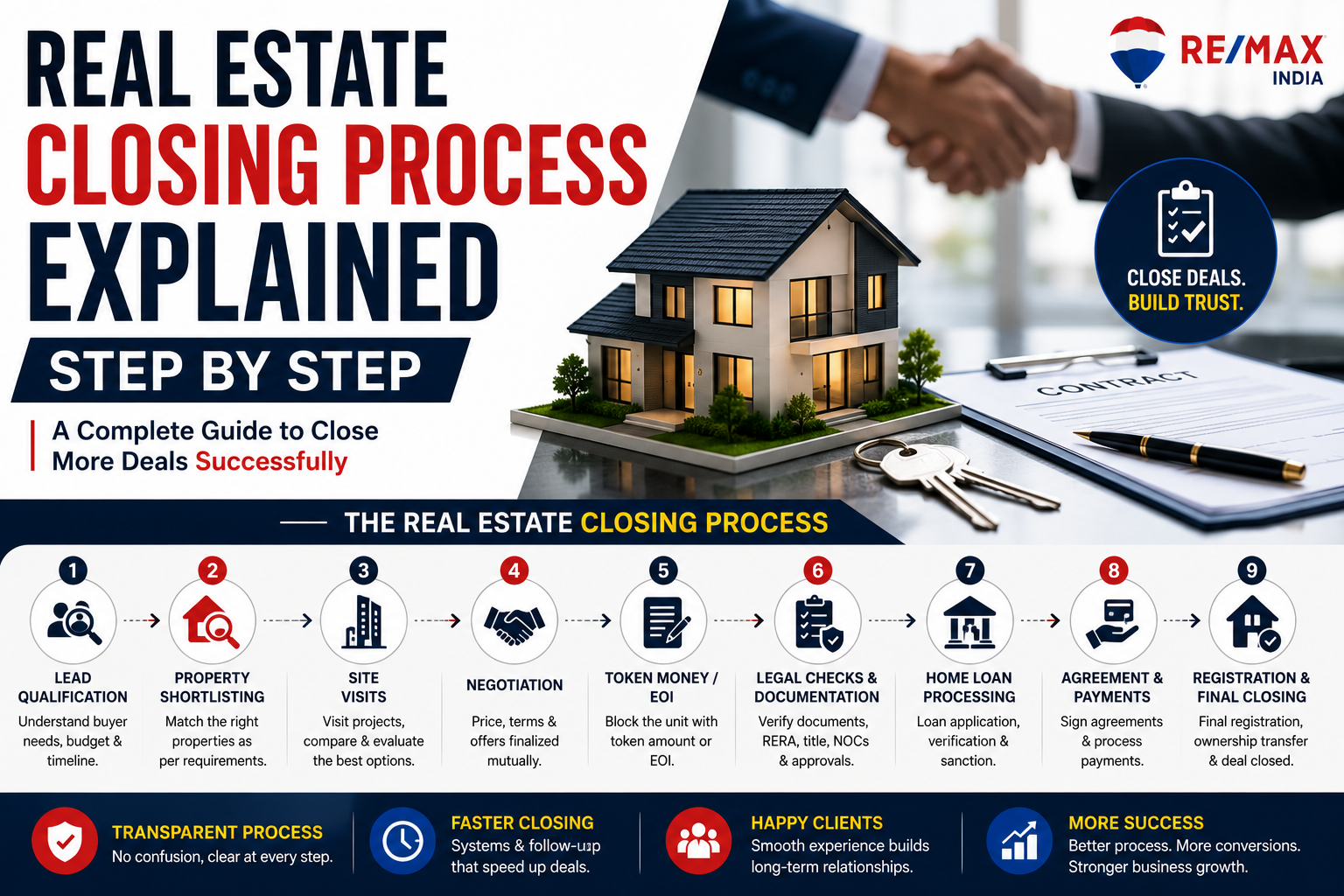
This article breaks down the actual real estate closing process step by step — the same way organised brokerage companies and professional real estate teams handle transactions in India.
Step 1: Lead Qualification
The closing process actually starts much earlier than most people think.
It starts the moment a lead enters the system.
Because not every lead is genuinely ready to buy.
Professional brokers first qualify:
- budget range
- location preference
- loan eligibility
- purchase timeline
- end use vs investment intent
- decision-maker involvement
This stage is extremely important.
Because poor qualification wastes:
- site visits
- sales resources
- broker time
- marketing spend
Aur yahi jagah par most brokers already start losing efficiency.
What Professional Brokers Usually Qualify First
| Qualification Area | Why It Matters |
|---|---|
| Budget | Avoid mismatched inventory |
| Loan Status | Understand financial capability |
| Timeline | Measure buying seriousness |
| Preferred Location | Filter inventory faster |
| Decision Maker | Avoid delayed negotiations |
| Purpose | Investment vs self-use strategy |
Step 2: Property Shortlisting
Once qualification is complete, brokers shortlist suitable inventory.
This stage involves:
- inventory filtering
- budget matching
- builder reputation checks
- location comparison
- floor plan analysis
- pricing comparisons
Professional brokerages usually present:
- 2–5 serious options
instead of overwhelming buyers with random inventory.
Because too many options often reduce decision speed.
Step 3: Site Visits
This is where many deals emotionally move forward.
Because buyers rarely purchase property only through brochures.
Site visits build confidence.
During this stage brokers usually handle:
- project walkthroughs
- sample flat tours
- location understanding
- builder presentations
- amenity explanations
- pricing discussions
Professional brokers also observe buyer reactions carefully.
Because often:
- questions reveal objections
- body language reveals hesitation
- family discussions reveal buying intent
This stage is more psychological than most people realise.
Step 4: Negotiation
This is one of the most misunderstood parts of brokerage.
People think negotiation only means:
“price kam karwa do.”
Actual negotiation involves much more:
- pricing
- payment plans
- floor preferences
- PLC adjustments
- builder offers
- possession timelines
- furnishing discussions
- legal assurances
Good brokers don’t only negotiate discounts.
They reduce buyer uncertainty.
That’s what actually improves closing probability.
What Usually Gets Negotiated In Real Estate Deals
| Negotiation Area | Typical Discussion |
|---|---|
| Base Price | Rate per sq ft adjustment |
| PLC Charges | Floor/view premiums |
| Payment Plan | Construction-linked or flexible |
| Offers | Waivers, gifts, discounts |
| Possession Timeline | Delivery expectations |
| Registration Charges | Who bears costs |
Step 5: Token Money / Expression Of Interest
Once serious intent develops, buyers often pay:
- token amount
- booking amount
- EOI (Expression of Interest)
This temporarily blocks inventory.
The amount varies depending on:
- builder policies
- project category
- market demand
At this stage, buyers usually become emotionally committed.
But the deal is still not fully secure yet.
Many transactions still collapse after token stages due to:
- loan rejection
- family objections
- legal concerns
- financial restructuring
Step 6: Legal Verification & Documentation
This is where professional brokerages become extremely valuable.
Because documentation complexity in India can become serious.
The process may involve:
- title verification
- RERA checks
- builder approvals
- NOC verification
- agreement review
- payment schedule validation
- due diligence
In resale transactions, this stage becomes even more critical.
Because ownership history and encumbrances must be verified properly.
Important Documents Usually Checked
| Document | Purpose |
|---|---|
| RERA Registration | Project legal compliance |
| Title Documents | Ownership verification |
| Builder-Buyer Agreement | Transaction terms |
| Payment Schedule | Financial structure |
| Loan Approval Documents | Financing validation |
| NOCs & Approvals | Legal clearances |
Step 7: Home Loan Processing
In India, many transactions depend heavily on financing.
Which means brokers often coordinate:
- bank communication
- document collection
- eligibility calculation
- loan sanction follow-ups
- technical verification
- disbursement coordination
Loan delays are one of the biggest reasons deals slow down.
This is why organised brokerage offices increasingly maintain:
- bank partnerships
- loan support teams
- documentation coordinators
Step 8: Agreement Signing & Payment Processing
Once legal and financial approvals are completed:
- agreements get signed
- payment schedules activate
- builder confirmations happen
- bank disbursement begins
This stage requires careful coordination because:
- documentation errors create delays
- payment mismatches create disputes
- compliance gaps create legal risks
Professional transaction management becomes extremely important here.
Step 9: Registration & Final Closing
Finally comes:
- registration
- stamp duty payment
- ownership transfer
- official execution
This is the actual legal completion of the transaction.
At this stage:
- documents are officially registered
- ownership gets transferred
- broker commissions are processed
And the deal becomes formally closed.
Why Many Real Estate Deals Fail Before Closing
This is important to understand.
Even serious deals can collapse.
Common reasons include:
- loan rejection
- family disagreement
- delayed follow-up
- pricing conflicts
- documentation confusion
- poor broker communication
- buyer hesitation
This is why organised brokerages focus heavily on:
- CRM systems
- follow-up workflows
- process discipline
- client coordination
Because closing itself is operational management.
What Professional Brokerages Usually Handle During Closing
| Operational Area | Broker Responsibility |
|---|---|
| Lead Qualification | Buyer filtering |
| Inventory Selection | Property matching |
| Negotiation | Pricing & terms |
| Documentation | Coordination & guidance |
| Loan Assistance | Bank coordination |
| Follow-Up | Buyer engagement |
| Final Registration | Execution support |
Why Organised Brokerage Companies Close More Deals
This is becoming increasingly visible across India.
Organised brokerage firms usually close more efficiently because they operate with:
- CRM systems
- structured follow-up
- team coordination
- documentation workflows
- builder relationships
- loan assistance systems
That reduces transaction friction massively.
Because eventually:
real estate closing is not just sales.
It’s coordination management.
Final Thoughts
The real estate closing process is much more detailed than most outsiders realise.
A successful transaction usually depends on:
- qualification
- trust-building
- inventory matching
- negotiation
- documentation
- loan coordination
- process management
And this is exactly why professional brokerage infrastructure matters so much.
Because eventually:
deals rarely close themselves.
They are managed step by step.
Through systems.
Through follow-up.
Through operational discipline.