How to Start a Real Estate Business in India Without Experience (2026 Guide)
Here's something most real estate articles won't tell you: about 70% of the people who start a real estate franchise don't come from a real estate background.
They're IT managers. Textile business owners. Ex-bankers. Retired army officers. Restaurant owners who got tired of 4 AM kitchen runs. Corporate executives who spent 15 years building someone else's company and finally decided enough was enough.
None of them knew the difference between a BBA and an agreement to sell when they started. Most of them couldn't tell you what RERA compliance involved. A few of them had never even visited a property registration office.
And yet, many of them now run profitable real estate businesses.
So let's address the elephant in the room: you don't need real estate experience to start a real estate business in India. What you need is something else entirely — and this guide lays out exactly what that is, step by step, with no motivational fluff and no sugarcoating about the parts that are genuinely hard.
Why Non-Real-Estate People Are Entering This Industry
Before we get into the "how," it's worth understanding the "why." Why are people with zero real estate background suddenly interested in a ₹1,00,000 Crore brokerage market?
Three reasons keep showing up in conversations.
The income ceiling is real in most industries. If you're a corporate employee earning ₹15-25 Lakhs annually, you already know the math. Your salary will grow 8-12% per year if your company does well. In 10 years, you'll earn roughly double what you earn today. Not bad — but not life-changing either. Real estate brokerage, structured properly, can generate ₹30-75 Lakhs annually within 2-3 years. Not for everyone, not guaranteed — but the ceiling is dramatically higher than a salary increment cycle.
Independence is addictive once you've tasted it. Most business owners from other industries — textile, FMCG, retail — are already comfortable running operations. They understand team management, cash flow, customer acquisition. What they want is a new vertical that's scalable without massive capital expenditure. Real estate brokerage fits because the asset isn't inventory (you don't buy property to resell it) — the asset is your team's ability to connect buyers and sellers. Low inventory cost, high skill leverage.
The market itself is screaming for professionals. India's brokerage market is 90% unorganised. Ninety percent. That means 9 out of 10 property transactions in this country are facilitated by someone with no formal training, no CRM, no marketing system, no brand — just a mobile phone, a notebook, and a few contacts. RERA is tightening regulations. Buyers want accountability. NRIs refuse to work with unbranded operators. The professionals who enter this market now — even without prior experience — are entering a vacuum that's begging to be filled.
The Myth: "Mujhse Nahi Hoga" (I Can't Do This)
Let's deal with this directly, because it stops more potentially great business owners than any financial constraint ever does.
"I don't know anything about real estate. How will I sell property? I don't know any builders. I don't know how transactions work. I've never even dealt with a registrar office. Mujhse nahi hoga."
Fair enough. That feeling is valid. But let's break it down logically.
Did you know everything about your current job when you started? If you're an IT professional, did you join Infosys or TCS knowing how to write production-grade code on day one? No — you went through training, learned on the job, and gradually became competent. If you're a business owner, did you know how to manage suppliers, negotiate with distributors, and handle GST compliance before you started? Of course not. You figured it out.
Real estate is no different. It's a skill — and skills can be learned. What can't be taught is willingness, consistency, and the ability to deal with people. If you have those three things, the real estate knowledge can be layered on top.
This is not about what you know today. It's about whether you're willing to learn and stay consistent for a few months. That's the real difference between people who succeed and people who stay stuck in the "exploring" phase forever.
What You Actually Need (It's Not What You Think)
Let's separate what's necessary from what people assume is necessary.
You DO Need:
People skills. Real estate is a relationship business. Not in the vague, Instagram-quote way — in the "can you sit across from a buyer spending ₹80 Lakhs and make them feel comfortable?" way. You need to be able to interact with people, lead a small team, and handle conversations where lakhs of rupees are on the table. If you're deeply introverted and the idea of calling a stranger makes you physically uncomfortable, this will be hard. Not impossible — but genuinely hard.
₹8-30 Lakhs in available capital. Starting a real estate business requires investment — whether you go the franchise route (₹8-15 Lakhs franchise fee + setup costs) or the solo route (branding, CRM, marketing, office, working capital). You need this money without going into financial distress. Borrowing heavily at 14% interest to fund a business that takes 6-12 months to stabilise is a recipe for panic. And panic makes people quit.
6-12 months of patience. Real estate rewards consistency more than speed. 80% of people who enter real estate think it's about doing deals and making quick money. It's not. It's about building a brand, a system, and a pipeline — and then the money follows. If you expect ₹5 Lakhs in month one, you'll be disappointed. If you're okay building for 6-12 months while the system gains traction, you'll likely be very happy with where you land.
Full-time commitment (eventually). You can explore and start the process while keeping your current job. But within 2-3 months, this needs to become your primary focus. Agent recruitment, training sessions, developer meetings, site visits, marketing reviews — these don't happen on weekends. Part-time effort produces part-time results.
You DON'T Need:
Prior real estate experience. Already addressed, but worth repeating: 70% of franchise enquiries at REMAX come from non-real-estate backgrounds. The system is built for exactly this.
Builder connections. A franchise gives you access to 1,000+ developer tie-ups from day one. You don't need to spend 3 years networking at builder lunches to get your foot in the door. The relationships are already built.
A marketing degree. The franchise provides a 12-person in-house marketing team that runs your campaigns across Meta, Google, and LinkedIn. You don't need to know how to set up a Facebook Ad Manager campaign. They do it.
Knowledge of RERA compliance, transaction documentation, or registration procedures. These are all covered in structured training. You learn them systematically instead of figuring them out through expensive mistakes.
A real estate license. India doesn't currently require a national license to operate as a real estate broker (though some states are moving toward mandatory broker registration under RERA). What you need is a registered business entity and RERA registration in your state — both of which the franchise onboarding process helps you set up.
The Two Paths: Random Entry vs Structured Entry
Most people who enter real estate in India follow what we'll call the "random path." And most of them fail within 2 years.
The Random Path (How 90% of People Do It)
You "know someone" who's making money in real estate. You start by helping them with a few deals — maybe earn a commission split. You think, "this is easy, I should do it myself." You rent a small office. Put up a board saying "XYZ Properties." You list some properties on 99acres and MagicBricks. You get a few leads. You fumble through the first transaction — don't know the documentation, don't know how to handle the buyer's loan application, barely scrape through the registration process.
You earn some money. But it's inconsistent. One month you close a deal, next two months nothing. You don't have a system for follow-ups, so leads go cold. You don't know how to run Facebook Ads properly, so you burn ₹50,000 and get 3 tyre-kicker leads. Your "agents" are really just friends you convinced to "try real estate," and they leave after 2 months because there's no training, no structure, and no income.
After 18 months, you've spent ₹10-15 Lakhs, earned maybe ₹3-5 Lakhs total, and you're exhausted. You either quit or shrink into a one-man operation running out of your living room.
This isn't hypothetical. This is the story of thousands of "local brokerages" across India. The graveyard of brands that either failed within 2 years or got squeezed into a 100-square-foot office because they had no system and no infrastructure.
The Structured Path
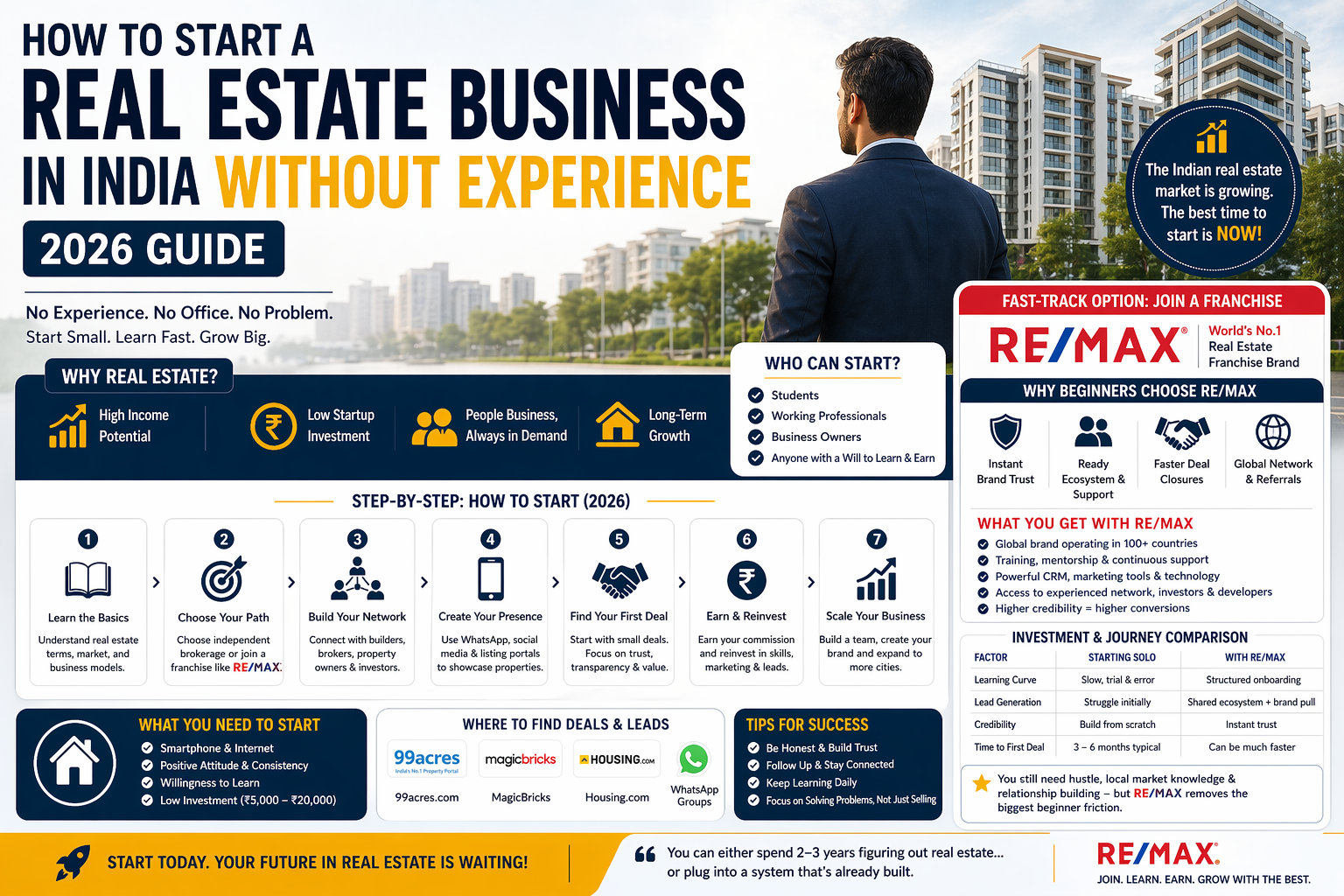
There's a different sequence that works. It has four stages, and the order matters:
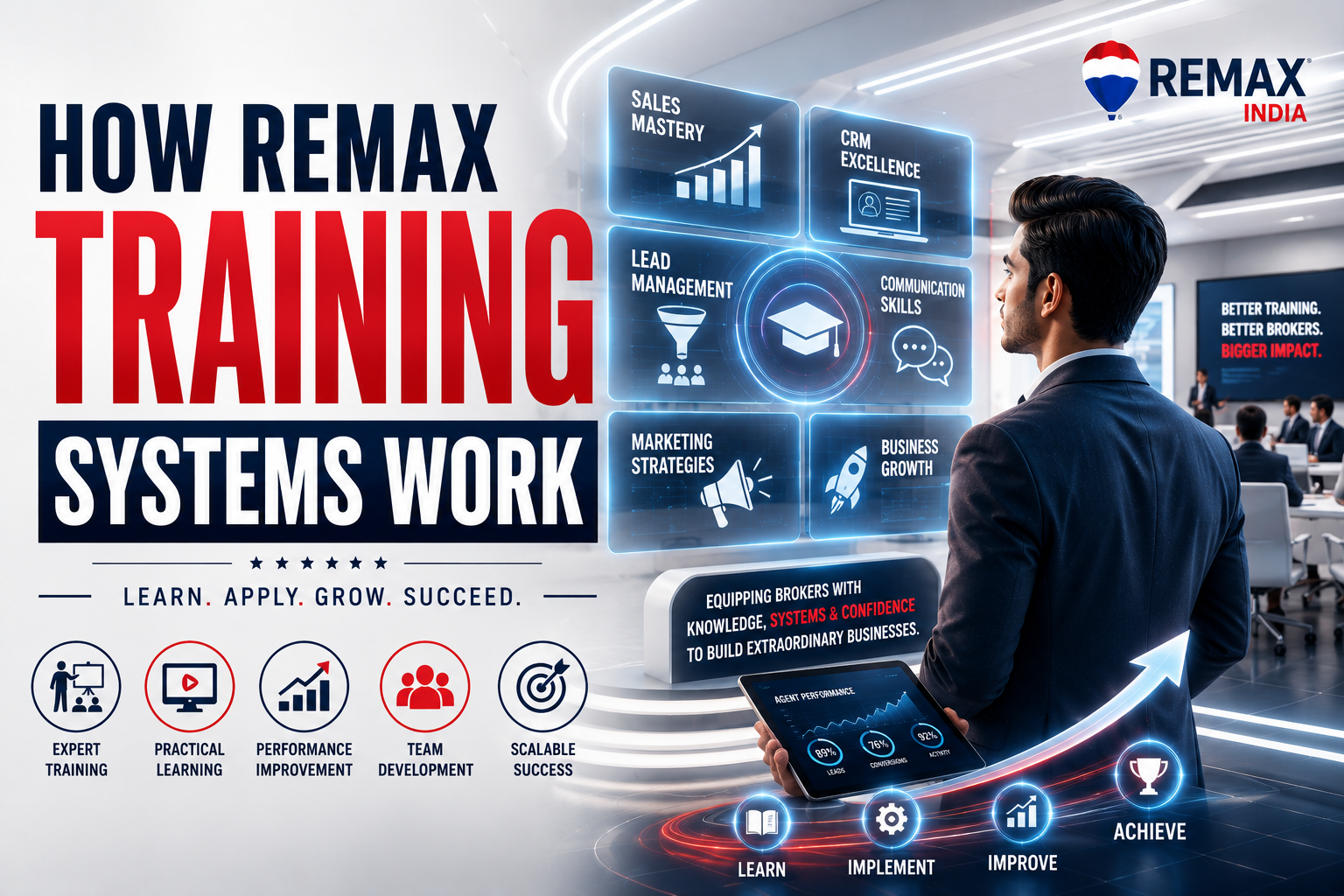
Stage 1: Learn. Before you try to earn a single rupee, invest 60-90 days in learning the business properly. Not YouTube videos. Not "ask my broker friend." A structured training programme that covers lead generation, client management, transaction processes, negotiation, compliance, and market analysis. REMAX's REPA Academy does exactly this — 90 days, NSDC-approved, chapter-wise exams. You and your agents go through it together. You come out knowing how the business actually works, not how you imagine it works.
Stage 2: Earn. Start closing deals using the system. Your first 2-3 deals will feel clunky — that's normal. But because you've been trained, you'll handle documentation correctly, follow up systematically, and avoid the rookie mistakes that cost untrained brokers lakhs in lost deals. Most franchise owners close their first deal within 45-60 days of going operational.
Stage 3: Stabilise. Build your agent team to 5-8 people. Create consistent deal flow through the marketing system and referral network. Develop relationships with 10-15 developers in your city. At this stage (roughly 6-12 months in), your income becomes predictable. You're no longer hustling for every deal — the pipeline is generating activity on its own.
Stage 4: Grow. Scale to 10-15 agents. Take on higher-ticket transactions. Structure developer mandates. Tap into the international referral network for NRI clients. This is where the third revenue stream — value-added services — starts becoming your most profitable line. The business is now scalable without scaling the operation cost.
The difference between these two paths isn't talent, intelligence, or connections. It's structure. One path gives you structure from day one so you don't waste 2-3 years of your life figuring things out. The other path is trial by fire — expensive, slow, and survivable by only the toughest (or luckiest) 10-20%.
How REPA Academy Solves the "No Experience" Problem
We keep referencing REPA because it's the single most relevant answer to the question this entire article is about. So let's go deep on what it actually is.
REPA stands for Real Estate Professional Academy. It's NSDC-approved (National Skill Development Corporation — a government-recognised certification body, not a self-issued credential). The programme runs for 90 days.
What it covers:
- Facebook and Google marketing specifically for real estate lead generation
- Lead management, CRM usage, and follow-up systems
- Residential buying and selling — end-to-end transaction process
- Commercial leasing — office, retail, warehouse
- Industrial and warehousing real estate
- Apartment and housing society sales
- Pricing strategy and comparative market analysis
- Negotiation techniques and deal structuring
- RERA compliance, documentation, and legal basics
Every chapter ends with an exam. Not a "tick yes if you watched the video" quiz — an actual assessment that verifies comprehension. If someone passes REPA, they know the business. Period.
Here's why this matters for you specifically as a non-real-estate person: you don't have to train your agents yourself. Think about what that means. You're a textile business owner entering real estate. You hire 5 agents. In the solo route, you'd have to personally teach them everything — and you don't know it yourself yet. With REPA, the system trains them. They go through the 90-day programme, come out certified, and start producing. You focus on managing the business — which is the skill you already have.
The team internally calls REPA "the MBBS of Real Estate." It takes a beginner — someone who's never done a single property transaction — and turns them into a functional professional in 90 days. That compression of learning is the entire reason non-real-estate people can succeed in this business.
The Income Reality (With Math, Not Promises)
Now naturally, one question comes up: how much can you actually earn from this?
And the honest answer is — it depends on your activity and consistency. Anyone who gives you a guaranteed number is lying. But what we can show you is the model's math, and you can judge for yourself whether it makes sense.
A real estate franchise generates income from three streams:
| Revenue Stream | How It Works | Monthly Example (5 Agents) |
|---|---|---|
| Commission Share | 14-34% of each agent's transaction commission | ₹3,00,000 (5 agents × 2 deals × ₹30K your share) |
| Agent Desk Fees | ₹3,000-6,000/month per agent | ₹25,000 (5 × ₹5,000) |
| Value-Added Services | Deal structuring, mandates, developer events | Variable — grows with experience |
| Gross Monthly Revenue | ₹3,25,000+ |
After expenses (royalty, agent fees to REMAX, office costs), a 5-agent office in a Tier 2 city nets approximately ₹2 Lakhs/month — roughly ₹24 Lakhs per year. Scale to 10 agents and you're looking at ₹50+ Lakhs annually.
What matters more than the exact number is the structure. In a structured system, even small consistent activity starts compounding. One agent does one deal, earns confidence, does two next month. You add a second agent, then a third. The referral network starts sending leads. A developer event brings in 5 warm prospects. It compounds. In an unstructured setup, even effort feels random — you work hard but nothing stacks.
For the complete cost and ROI breakdown, read our franchise cost analysis.
A Step-by-Step Path for the Complete Beginner
If you're starting from absolute zero, here's the practical sequence:
Month 0: Research and Decision (2-4 weeks)
Read this article. Read the complete real estate franchise guide. Check the city market reports for your region. Understand the business model, the investment, and the time commitment. Talk to your family about the financial and time implications. Be honest about whether you can commit 6-12 months of full-time effort.
Month 1: Enquiry and Briefing (1-2 weeks)
Fill the eligibility form. Get on the Zoom briefing call. Ask every question you have — income projections, territory availability, support details, exit terms. Don't sign anything until you've slept on it for at least a week.
Month 1-2: Onboarding and Setup (3-4 weeks)
Franchise agreement signed. Office location finalised. Branding deployed. REPA Academy enrolment begins — for you and your first agents. CRM set up. Marketing campaigns designed with the in-house team. Agent recruitment event planned.
Month 2-3: Launch and First Activity
Office opens. REPA training ongoing. Marketing campaigns live — first leads start coming in. You're attending developer meetings, building local relationships, getting comfortable with the transaction process. First deal often happens somewhere in this window.
Month 3-6: Building the Pipeline
Agent team growing to 5-8. Deal flow becoming more consistent. You're learning what works in your specific city — which localities sell, which developers respond, which marketing channels convert. This is the grind phase. It's not glamorous. But it's where the foundation gets built.
Month 6-12: Stabilisation
Income becomes predictable. You know your numbers — cost per lead, conversion rate, average deal size, average commission. You're not guessing anymore. You're operating a business with real metrics. From here, scaling is a matter of adding agents and expanding activity — the system handles the rest.
The Three Questions That Actually Matter
Forget "do I need experience?" You don't. These are the three questions that determine whether you'll succeed:
1. Can you stay consistent for 6 months without seeing big results?
Most people enter real estate randomly, do a few deals, get confused, and drop out. The ones who succeed follow the structured path — learn first, earn next, stabilise, then grow. But between "learn" and "stabilise" there's a 4-6 month window where you're working hard and the returns aren't dramatic yet. Can you handle that? If yes, you'll likely make it. If you need instant gratification, you won't — and that's not a character flaw, it just means this particular business model doesn't suit your temperament.
2. Are you comfortable leading a small team?
You don't do the deals yourself — your agents do. Your job is to recruit them, ensure they're trained (REPA handles this), support their activity, and keep the office running. If you've ever managed even 3-5 people in any context — a business, a corporate team, a family shop — you have enough management skill for this. If the idea of leading people sounds exhausting rather than energising, think carefully.
3. Are you doing this for the right reasons?
Income potential? Good reason. Building an asset? Good reason. Independence and autonomy? Good reason. "My cousin made ₹10 Lakhs in one deal and I want that too?" Bad reason — because that's chasing a one-time event, not building a business. Real estate rewards consistency more than speed. Make sure you're here for the marathon, not the sprint.
Frequently Asked Questions
I'm 45 and have been in textile/FMCG/IT my whole career. Am I too late?
No. The ideal age range for franchise owners is 28-50, and some of the most successful ones started in their 40s. Why? Because they bring business maturity, financial stability, and network depth. You're not "starting over" — you're applying decades of business experience to a new industry. The real estate knowledge gap is filled by REPA Academy. Your management skills don't expire.
How much time before I can leave my current job?
Most franchise owners begin the process while employed and transition to full-time within 2-3 months of signing. The first month (onboarding, REPA, office setup) can overlap with your notice period if timed right. But don't plan to run this permanently alongside a demanding corporate job — it needs your full attention to work.
What if I don't know anyone in real estate in my city?
That's precisely what the franchise infrastructure solves. The in-house marketing team generates leads (you don't need personal contacts for that). The developer tie-ups give you access to 1,000+ builders (you don't need personal builder relationships). The agent recruitment event helps you find team members (you don't need to know brokers already). And the cross-referral network across 25+ cities and 112 countries gives you a pipeline that would take decades to build solo.
Starting with zero local connections is actually more common than starting with a network. The system is designed for exactly this.
What if I try and it doesn't work out?
Valid concern. There is no guarantee of outcome in any business — there is only clarity of model. The real question is: does a structured system with training, marketing, brand, technology, and a global network give you better odds than starting solo? If the answer is yes, the risk calculus makes sense. If you're still uncertain, the Zoom briefing call is a no-commitment conversation where you can ask everything — including what happens if you want to exit.
Do I need to physically sell property myself?
Not necessarily. As the franchise owner, your primary role is building and managing the team, not doing individual transactions. Your agents handle site visits, client meetings, and closings. You manage the business — recruitment, training oversight, developer relationships, marketing review, and office operations. That said, most owners do participate in some deals early on to understand the process. But the long-term model is management, not sales.
The Bottom Line
Here's the uncomfortable truth about real estate in India: the bar is incredibly low. Not in a "this is easy" way — in a "most of the market has no standards" way. When 90% of brokers are untrained, unbranded, and unstructured, simply being trained, branded, and structured puts you in the top 10% of the market. That's your competitive advantage — not real estate experience, but professional discipline applied to a sector that desperately lacks it.
You don't need to have sold a single property in your life to build a real estate business. You need willingness to learn (90 days of REPA Academy). You need consistency (6-12 months of building the pipeline). You need people skills (managing a team of 5-15 agents). And you need capital (₹8-15 Lakhs franchise fee + setup costs).
Most people who explore this idea stay in the "exploring" phase for months, sometimes years. Right now you're exploring — which is good. But without structure, people keep exploring forever without results.
The structured path is straightforward: learn, then earn, then stabilise, then grow. Everything you need for that path is already built — the training, the marketing, the technology, the network, the brand.
The only piece missing is you.
Fill the REMAX eligibility form — 7 questions, 2 minutes, and you'll know within 24 hours whether your city territory is available. No commitment, no payment, no pressure. Just clarity.