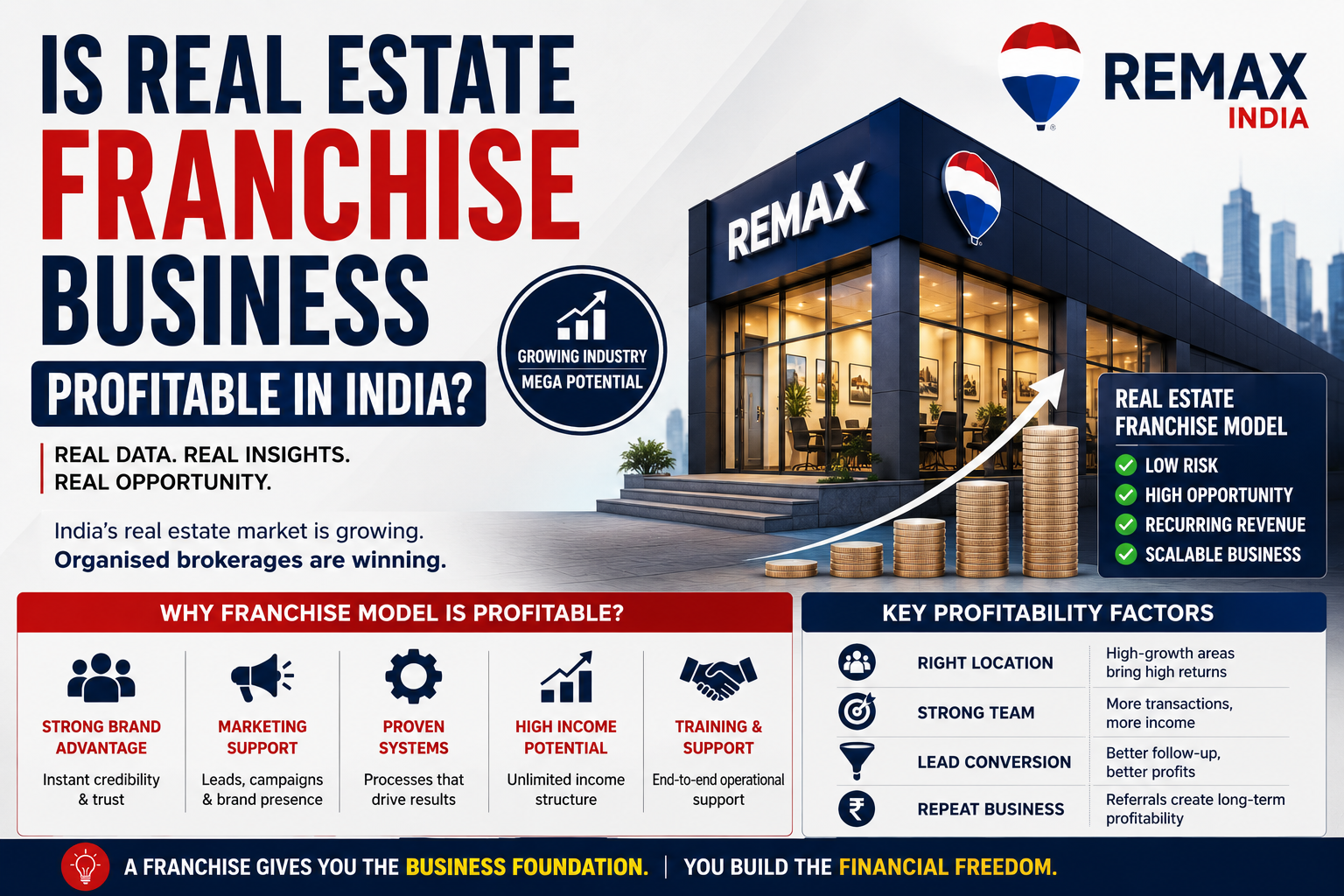
Is Real Estate Franchise Business Profitable in India?
Short answer?
Yes.
But not in the way most people think.
A lot of people enter real estate believing profitability comes from simply selling expensive properties.
“Bas ek ₹2 Crore deal close hui toh business set.”
Reality is very different.
The actual profitability of a real estate franchise business comes from systems, repeatability, brand trust, team scalability, and operational structure.
That’s why organised brokerage companies are growing rapidly across India while thousands of independent brokers remain stuck at inconsistent income levels.
The Indian real estate market itself is enormous.
Residential demand continues rising.
Commercial expansion is accelerating.
Tier-2 cities are becoming investment hotspots.
And increasingly, buyers want organised professional brokerages instead of unstructured local operators.
That shift is creating a major business opportunity.
Why Real Estate Franchise Businesses Are Growing Fast
Traditional brokerage in India has historically been highly unorganised.
Most brokerages depended entirely on:
- personal contacts
- manual follow-ups
- local referrals
- individual reputation
- WhatsApp communication
That model worked earlier.
But the market has changed.
Today’s clients expect:
- professional branding
- structured communication
- CRM updates
- digital inventory sharing
- faster response time
- process-driven transactions
Especially in premium transactions.
And this is exactly where organised franchise brokerages gain a huge advantage.
Independent Brokerage vs Franchise Brokerage
| Independent Brokerage | Franchise Brokerage |
|---|---|
| Build everything from scratch | Plug into existing systems |
| Limited brand trust initially | Established market credibility |
| Manual operational setup | Structured business model |
| Weak recruitment power | Stronger agent attraction |
| Random lead systems | CRM workflows & processes |
| Slow scalability | Faster operational scaling |
| Founder dependent | Team-oriented growth |
Where Does The Profit Actually Come From?
Most people assume brokerage profit comes only from commissions.
That’s partially true.
But scalable franchise brokerages create multiple revenue streams.
That includes:
- primary property sales
- resale commissions
- luxury transactions
- commercial leasing
- developer mandates
- rental services
- agent desk fees
- team revenue sharing
Once operations become structured, the business no longer depends only on the founder personally closing deals.
That changes profitability completely.
Typical Brokerage Revenue Structure
| Revenue Source | Typical Earnings Potential |
|---|---|
| Primary Sales | ₹50,000–₹5 Lakhs per deal |
| Luxury Transactions | ₹2–20 Lakhs per deal |
| Commercial Leasing | ₹1–30 Lakhs commissions |
| Resale Market | Dual-side commissions possible |
| Team Revenue Share | Recurring monthly income |
| Developer Partnerships | Long-term inventory access |
The Biggest Reason Most Brokerages Stay Unprofitable
This is important.
Most brokerage businesses don’t fail because the market is weak.
They fail because operational systems are weak.
Leads leak.
Follow-ups become inconsistent.
Teams lack accountability.
Recruitment becomes unstable.
And eventually the founder becomes overloaded handling everything manually.
That’s why many brokerage offices struggle to even cross ₹5–10 Lakhs/month consistently.
Because the infrastructure underneath cannot support scaling.
What Makes Franchise Brokerages More Scalable?
A franchise brokerage model reduces years of trial-and-error.
Instead of building everything manually from zero, franchise owners gain access to:
- brand positioning
- marketing systems
- CRM infrastructure
- agent training
- operational workflows
- lead management systems
- recruitment frameworks
- industry credibility
That dramatically improves operational efficiency.
And operational efficiency directly impacts profitability.
Because in brokerage…
better systems usually create:
- higher conversion rates
- better client retention
- stronger team productivity
- more predictable revenue
How Long Does It Take To Become Profitable?
This depends heavily on:
- city market
- team quality
- lead generation
- branding
- operational discipline
- founder involvement
However, organised brokerage offices with proper systems usually scale significantly faster than independent setups.
Especially if:
- the office focuses on recruitment early
- CRM discipline is strong
- marketing consistency exists
- lead flow remains active
The first 12–24 months are usually about building operational foundations.
After that?
Scalability starts compounding.
Real Estate Franchise Profitability Timeline
| Phase | Business Focus | Typical Outcome |
|---|---|---|
| 0–6 Months | Setup + branding + recruitment | Foundation building |
| 6–12 Months | Lead flow + operations | Market traction begins |
| 12–24 Months | Team scaling + repeat systems | Revenue consistency improves |
| 24+ Months | Operational expansion | Scalable profitability |
Why Organised Brokerages Will Dominate The Future
Indian real estate is becoming increasingly professional.
Clients today compare brokerages the same way they compare brands in other industries.
Trust matters more.
Systems matter more.
Operational quality matters more.
And this is exactly why organised franchise models are rapidly expanding across India now.
Because they combine:
- branding
- infrastructure
- technology
- training
- scalable systems
Instead of depending only on individual hustle.
Final Thoughts
So…
Is real estate franchise business profitable in India?
Very much yes.
But profitability doesn’t come from random commissions alone.
It comes from building structured operations that scale consistently over time.
The brokerage companies likely to dominate the next decade in India will probably not be the loudest brokers.
They’ll be the businesses with:
- strong systems
- professional branding
- CRM discipline
- recruitment infrastructure
- process-driven growth
- scalable operational models
Because eventually:
relationships may start a brokerage…
but systems build long-term brokerage businesses.