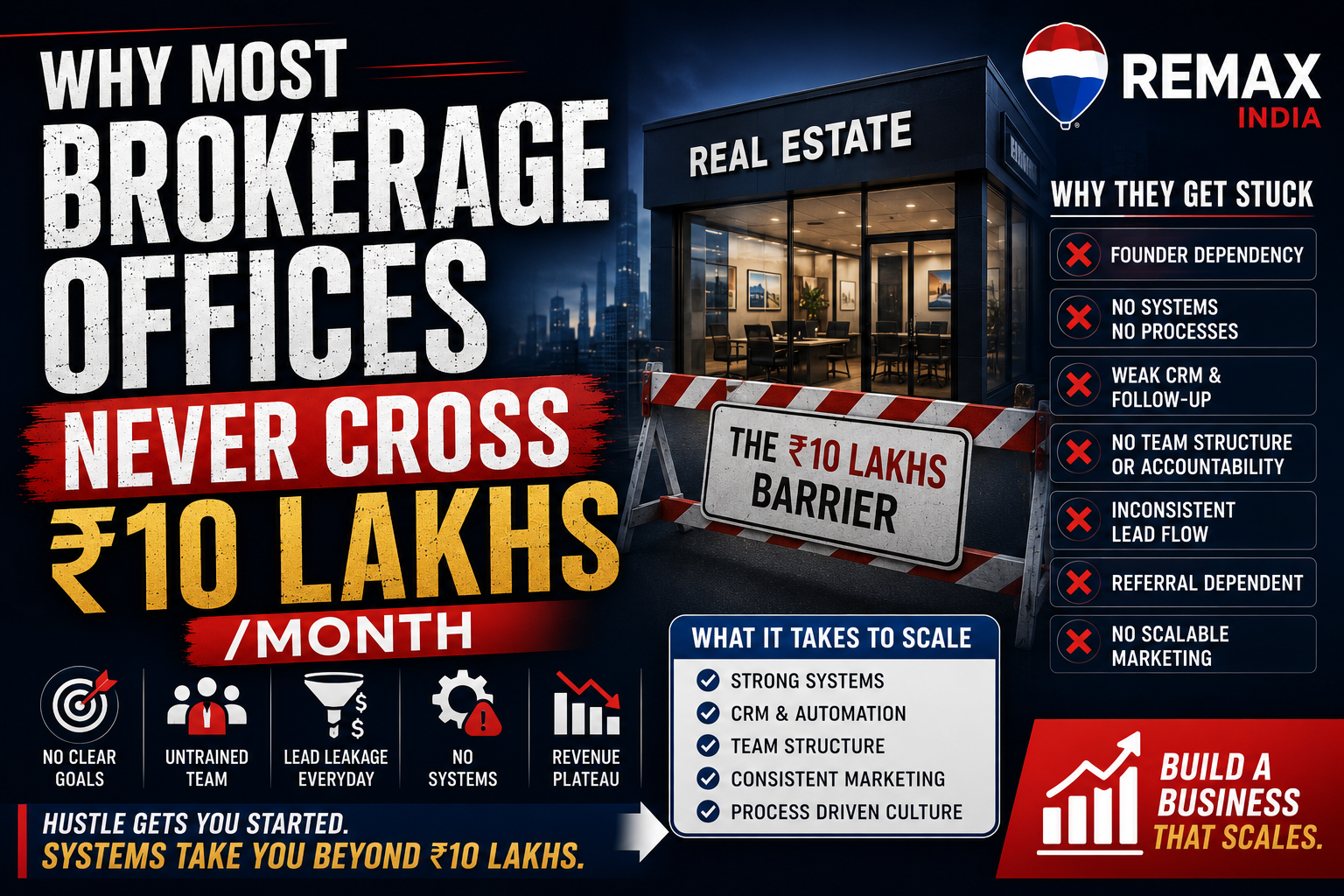
Why Most Brokerage Offices Never Cross ₹10 Lakhs/Month
India has lakhs of active real estate brokers.
But surprisingly, only a very small percentage of brokerage offices consistently cross ₹10 Lakhs/month revenue.
And honestly?
This has very little to do with market opportunity.
The Indian real estate market is massive.
Property transactions worth thousands of crores happen every single day across NCR, Mumbai, Pune, Bangalore, Hyderabad, Ahmedabad, Chennai, and Tier-2 cities.
Demand exists.
Inventory exists.
Buyers exist.
So why do most brokerage offices stay stuck between ₹2–7 Lakhs/month for years?
Because most brokerage businesses are designed for survival…
not scalability.
Most Brokerage Offices Are Actually Founder Jobs
This is the biggest hidden reality in Indian brokerage.
Most offices don’t operate like structured companies.
They operate like founder-dependent hustle systems.
The owner handles:
- lead generation
- client meetings
- builder coordination
- negotiations
- follow-up
- recruitment
- closing
- operations
Everything depends on one individual.
Initially this model works surprisingly well.
Especially when:
- the office is small
- team size is under 5 people
- lead volume is manageable
- the founder has strong local contacts
But once revenue starts increasing?
Complexity increases faster than the systems underneath.
Aur wahi growth ko break kar deta hai.
The ₹10 Lakhs Growth Barrier Explained
| Business Stage | What Usually Happens | Growth Result |
|---|---|---|
| ₹1–3 Lakhs/month | Founder-driven hustle | Fast early growth |
| ₹3–5 Lakhs/month | More referrals and inquiries | Business feels stable |
| ₹5–7 Lakhs/month | Team coordination pressure starts | Operational stress increases |
| ₹7–10 Lakhs/month | Lead leakage and inconsistency begin | Growth plateaus |
| Above ₹10 Lakhs/month | Systems become mandatory | Most brokerages struggle here |
The Referral Dependency Trap
Most brokerage offices in India heavily depend on referrals.
And referrals are amazing initially.
Low acquisition cost.
High trust.
Faster conversions.
But referrals alone rarely build scalable businesses.
Because referrals are relationship-driven.
Not infrastructure-driven.
Which means growth eventually slows naturally.
One month you close 4 deals.
Next month?
Almost nothing.
Revenue becomes unpredictable.
Cash flow becomes unstable.
And the founder starts working harder instead of building smarter systems.
Most Brokerage Teams Are Not Actually Structured Teams
This is another uncomfortable truth.
Many brokerage offices proudly say:
“Humari 15 member team hai.”
But when you actually observe operations?
It’s usually:
- random follow-ups
- no CRM discipline
- weak accountability
- duplicate lead handling
- poor reporting systems
- no structured processes
That’s not a scalable team.
That’s simply multiple individuals working independently under one roof.
Real scalability requires:
- lead management systems
- defined workflows
- tracking dashboards
- process documentation
- performance accountability
- operational discipline
Traditional Brokerage vs Scalable Brokerage Office
| Traditional Brokerage | Scalable Brokerage Model |
|---|---|
| Founder dependent | System dependent |
| Referral-heavy growth | Multiple lead channels |
| Manual follow-up | CRM workflows |
| No reporting systems | Data-driven management |
| Random recruitment | Structured hiring |
| Revenue inconsistency | Predictable scalability |
| Operational chaos | Process-driven execution |
The CRM Problem Nobody Talks About
A lot of brokerages think buying software solves scaling.
It doesn’t.
This is why many brokerage offices install CRMs…
but still fail operationally.
Because software without discipline changes nothing.
Agents still forget follow-ups.
Leads still leak.
Managers still lack visibility.
Aur phir blame aata hai:
“Lead quality weak thi.”
Sometimes the lead wasn’t weak.
The operational structure was weak.
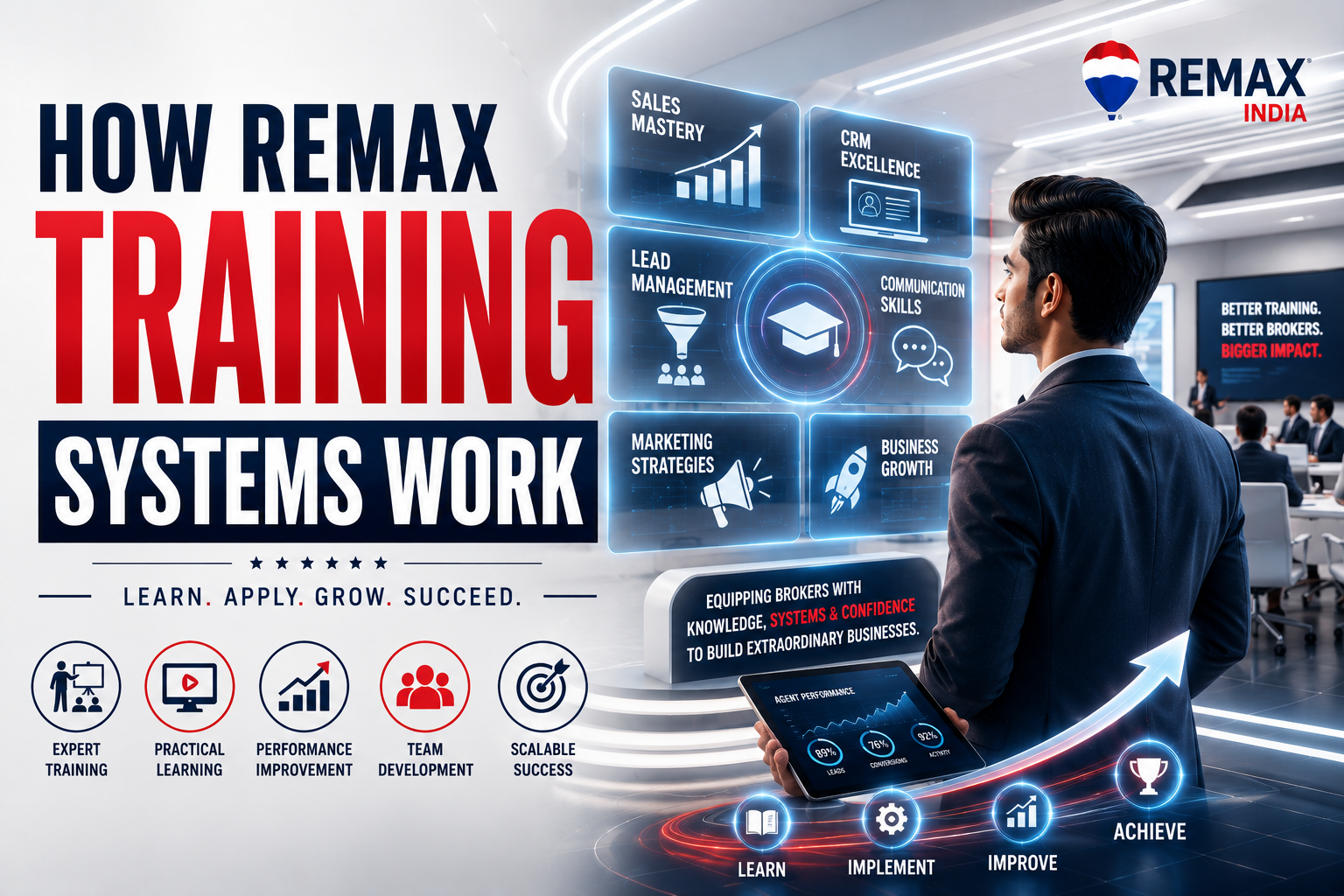
Why Organised Brokerage Models Are Scaling Faster
This is exactly why organised brokerage systems are growing rapidly across India now.
Because they focus heavily on operational infrastructure.
Not just sales motivation.
They build:
- CRM systems
- lead workflows
- branding consistency
- training structures
- marketing pipelines
- recruitment systems
- management visibility
Instead of rebuilding everything from zero, brokerage owners plug into structured infrastructure.
That changes scalability completely.
And honestly?
That’s one major reason organised franchise models are expanding aggressively now.
The Real Estate Industry Has Changed
Buyer expectations today are completely different compared to 10 years ago.
Modern clients expect:
- professional communication
- structured follow-up
- fast response time
- digital inventory sharing
- market knowledge
- trustworthy branding
Especially in premium transactions.
A client investing ₹2–5 Crores today doesn’t want operational chaos.
They want confidence.
And confidence increasingly comes from systems.
Not only relationships.
Final Thoughts
Most brokerage offices in India don’t fail because the market opportunity is small.
They fail because the operational structure underneath cannot support scale.
The ₹10 Lakhs/month barrier is usually not a sales problem.
It’s a systems problem.
The brokerage businesses that dominate the next decade will likely not be the loudest brokers.
They’ll be the businesses with:
- strong operations
- CRM discipline
- structured recruitment
- marketing systems
- brand trust
- process-driven growth
Because eventually:
hustle creates momentum…
but infrastructure creates scalability.