Why Corporate Professionals Are Switching to Real Estate Franchising in India
A few years ago, if you told an IT manager at Infosys or a VP at HDFC Bank that they'd be running a real estate brokerage, they'd have laughed. Real estate was for "broker types" — uncles with Nokia phones and a register full of plot numbers. Not for people with MBAs, corporate experience, and LinkedIn profiles.
That perception is cracking. Fast.
Across India — Noida, Pune, Ahmedabad, Bengaluru, Jaipur — people with 10-20 years of corporate experience are leaving comfortable salaried positions to start real estate franchise businesses. Not doing random property deals. Not becoming brokers in the traditional sense. Building structured real estate companies with teams, systems, and multiple revenue streams.
And they're doing it not because they're reckless, but because the math finally makes sense.
This article breaks down exactly why this shift is happening, what the real numbers look like when you compare a corporate salary to a franchise income, and why the franchise model specifically is what makes this transition possible for people with zero real estate background.
The Salary Ceiling Problem Nobody Talks About
Let's do the math that most people avoid doing.
Say you're a mid-senior corporate professional earning ₹20 Lakhs per annum. That's roughly ₹1,67,000 per month take-home. By Indian standards, that's a comfortable salary. By most measures, you're "doing well."
Now project forward 10 years. With average annual increments of 8-12%, your salary grows to roughly ₹40-50 Lakhs per annum. Maybe ₹60 Lakhs if you switch companies aggressively and get lucky with promotions. After 20 years of corporate life, you'll earn approximately double to triple your current salary.
Sounds reasonable. Until you look at what happened during those 20 years.
You built someone else's company. Hit someone else's targets. Took stress for someone else's P&L. Got a salary cut during COVID even after making a lot of money for the company directors — because that's how corporate employment works. When the market turns, your job security evaporates, regardless of how much revenue you generated.
This isn't bitterness. This is how salaried structures work. And a lot of corporate professionals between 30 and 45 are doing this math and arriving at the same conclusion: the salary model has a ceiling, and I'm either already there or I can see it from here.
Real estate brokerage, done right, doesn't have the same ceiling. It's an equity business — you're building an asset, not trading time for money. The income scales with your team, not your personal hours. And the ₹1,00,000 Crore brokerage market in India is 90% unorganised, which means there's an absurd amount of room for professionals who bring even basic corporate discipline to the table.
Why Real Estate? Why Now?
Corporate professionals don't quit their jobs on a whim. When they make moves, it's because multiple factors have aligned. Here's what's aligning right now.
The Market Is Begging for Professionalism
85-90% of India's real estate brokerage market is unorganised. That's not a statistic — that's a business opportunity written in neon lights. Most brokers in India have no CRM. No training. No marketing system. No RERA compliance awareness. No brand.
When NoBroker launched, they built a billion-dollar valuation by solving one problem: people wanted to avoid dealing with unorganised brokers. That's how bad the trust deficit is. Buyers are literally paying money to NOT interact with the current market.
Into this vacuum walks a corporate professional with 15 years of experience in operations, team management, process building, and client service. You don't need to know real estate — you need to bring the professional rigour that 90% of the market lacks. The real estate knowledge can be layered on top through structured training (more on that below).
NRI Money Needs Professional Handlers
NRI investments in Indian real estate currently account for 8-22% of the $450 billion market. Projections suggest this will reach 25% by 2030 — meaning one-fourth of all Indian real estate transactions will be NRI-driven.
NRIs sitting in Toronto, London, or Dubai do not call the local Sharma ji to handle their ₹2 Crore property purchase. They look for a recognisable brand, a professional process, documented compliance, and someone who returns their calls across time zones. This is exactly the kind of client a corporate professional is equipped to serve — and exactly the kind of client unorganised brokers lose.
RERA Changed the Rules
Before RERA, Indian real estate was essentially unregulated at the broker level. Any uncle with a visiting card could call himself a property advisor. Post-RERA, states are increasingly requiring broker registration, transparent disclosures, and accountability.
This regulatory shift favours organised, compliant operators and pressures the unregistered, no-process majority. If you're entering the market now with a structured franchise, RERA registration, and proper systems — you're positioning yourself on the right side of a permanent industry shift.
The Corporate Salary vs Franchise Income Comparison
Let's put real numbers on the table. Not theoretical projections — math based on conservative franchise assumptions.
| Parameter | Corporate Salary (₹20 LPA) | REMAX Franchise (5 Agents, Year 1) | REMAX Franchise (10 Agents, Year 2-3) |
|---|---|---|---|
| Annual Gross Income | ₹20,00,000 | ₹39,00,000 | ₹78,00,000 |
| Annual Take-Home (after tax/expenses) | ~₹14,50,000 | ~₹24,00,000 | ~₹53,00,000 |
| Income Growth Rate | 8-12%/year (increment-dependent) | Scales with agent count (no ceiling) | Scales with agent count (no ceiling) |
| Who Controls Growth? | Your manager / company | You | You |
| Asset Being Built | None (salary stops when job stops) | A business with resale value | A business with resale value |
| COVID/Recession Risk | Salary cut / layoff possible | Income dips but business survives | Diversified streams provide buffer |
| Initial Investment | ₹0 | ₹13-30L (franchise + setup + working capital) | Minimal incremental cost |
The franchise income numbers assume conservative deal flow: 5 agents doing 2 deals/month at ₹80 Lakh average deal size with 1.5% commission. Your share at 25% comes to roughly ₹3 Lakhs/month in commission share alone, plus desk fees. After royalty and expenses, net monthly income is approximately ₹2 Lakhs. Scale to 10 agents and it roughly doubles — without doubling your effort or costs. The business is scalable without scaling the operation cost.
Two things stand out in this table. First, the crossover happens fast. Even a conservative 5-agent franchise in Year 1 generates more take-home than a ₹20 LPA salary. Second — and more importantly — the salary has a ceiling tied to your company's increment cycle. The franchise has no ceiling. It scales with the number of agents and transactions, not with someone else's appraisal of your work.
For the complete cost and ROI breakdown, read our franchise cost analysis.
Why a Franchise (and Not Starting Solo)?
Here's where most corporate professionals get tripped up. The thinking goes: "I'm smart, I've managed teams, I've run P&Ls — why can't I just start my own brokerage?"
You can. Some people have. But understand what you're signing up for.
Starting "XYZ Properties" from scratch means: building a brand nobody's heard of (₹2-5 Lakhs for branding that doesn't look like it was made on Canva), buying or building a CRM (₹1-3 Lakhs/year), hiring a marketing agency or learning digital ads yourself (₹3-6 Lakhs/year in agency fees or wasted ad spend), creating a training programme for your agents (assuming you know what to teach them — you don't, yet), and building developer relationships from zero (1-3 years of networking before builders take you seriously).
Most people who try this spend 3 years and ₹50 Lakhs just to learn lessons REMAX already solved in the 1970s. Some survive it. Many end up in the graveyard of local brands that either failed within 2 years or got squeezed into a 100-square-foot office because they had no system and no infrastructure.
A franchise compresses that learning curve. You walk in on day one with:
- A 52-year-old global brand (NYSE-listed, 112+ countries, 9,200+ offices) — instant credibility you'd take 5-10 years to build solo
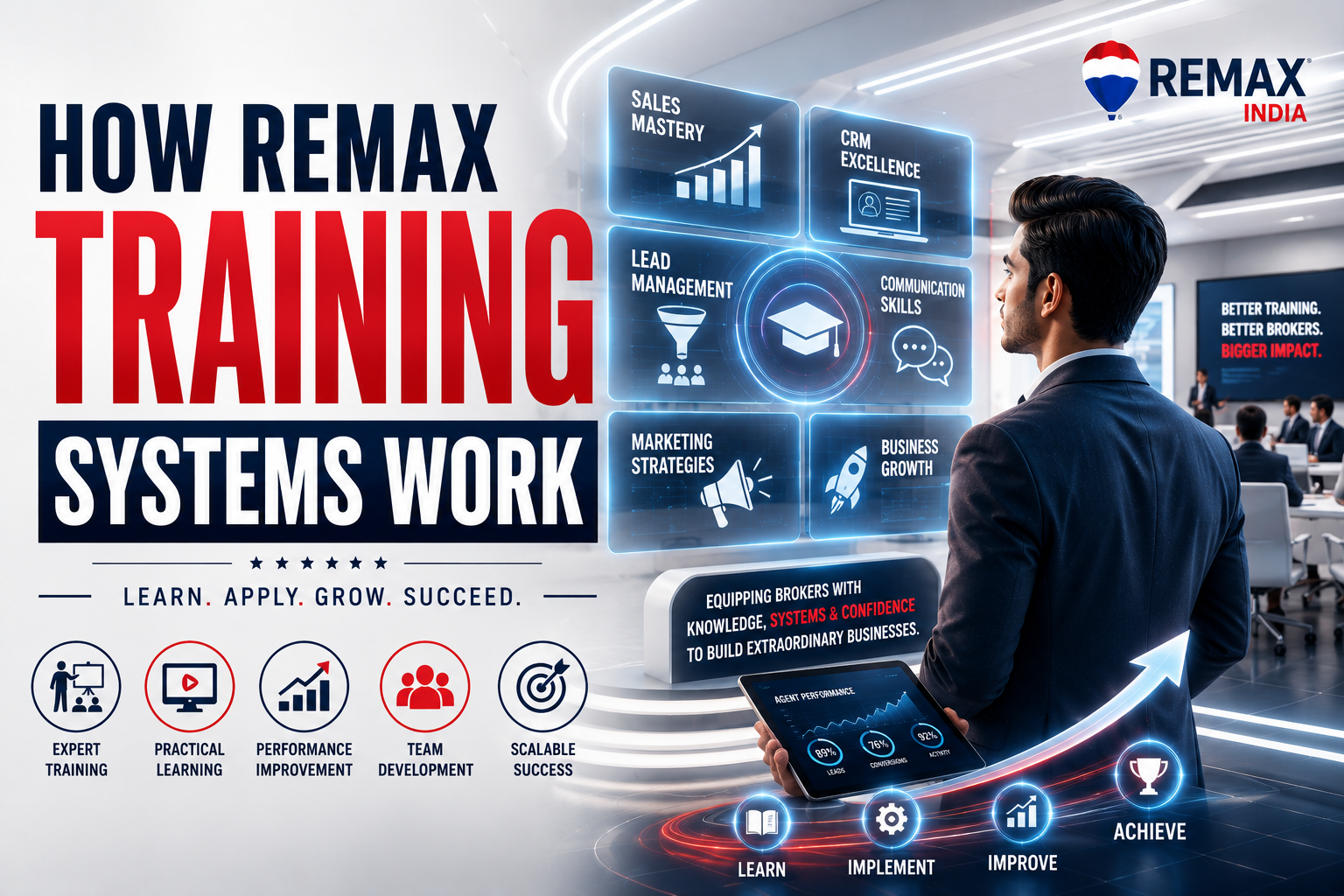
- REPA Academy — the MBBS of Real Estate. NSDC-approved, 90-day programme that trains your agents so you don't have to. Covers everything from Facebook marketing to deal structuring to RERA compliance. Chapter-wise exams.
- A 12-person in-house marketing team running your Meta, Google, and LinkedIn campaigns. A dedicated social media manager for your franchise. A separate content creation team. Leads generated at half the industry average cost.
- CRM, Authorisation Portal, KAKA AI — the full tech stack, no extra subscription costs
- 1,000+ developer tie-ups and 50+ Dubai builders. Property events where builders pay ₹10-20 Lakh per event and bear all expenses.
- Cross-referral network across 25+ Indian cities and 112 countries — a referred client carries 35-40% trust from day one
As a corporate professional, you already know how to manage a team, run operations, and read a P&L. You don't need to learn that. What you need is the industry-specific system — and the franchise gives you exactly that. You bring the management muscle. The franchise brings the real estate infrastructure.
The Corporate Skills That Transfer Directly
Here's what most "how to start in real estate" articles miss: corporate experience is massively undervalued in this industry. The skills you've built over 10-20 years are exactly what the real estate brokerage market is missing.
Process Discipline
You've built SOPs. You've run dashboards. You know what a funnel looks like. In real estate, where 90% of brokers have no process for anything — no follow-up system, no lead tracking, no pipeline management — your instinct to systematise things is a genuine competitive advantage. A CRM in the hands of an unorganised broker is just software. A CRM in the hands of someone who understands process is a revenue engine.
Team Management
You've managed people. You know how to hire, how to set expectations, how to review performance, how to fire when necessary. Most local brokers have never formally managed even one employee. Their "team" is a loose collection of part-timers who show up when they feel like it. Your ability to build a real team — with accountability, training, and performance metrics — puts you in a completely different league.
Client Handling
You've dealt with demanding corporate clients, managed stakeholder expectations, and navigated complex negotiations. A ₹1 Crore property buyer is no more intimidating than a ₹5 Crore client account you managed at your corporate job. In fact, the buyer is probably easier — there's one decision-maker (or a couple), not a 7-person committee with competing agendas.
Financial Literacy
You understand P&L, ROI, cash flow, breakeven. Most local brokers cannot tell you their cost per lead, their conversion rate, or their average deal cycle time. They operate on gut feel. You'll operate on data — and in any business, data beats gut feel over a 12-month period, every single time.
Professional Communication
Emails that make sense. Presentations that don't look like they were made in 2004. Phone calls that are structured and purposeful. WhatsApp messages that are spelled correctly. This sounds basic — but in an industry where the average broker's client communication is a blurry property photo with "GOOD DEAL CALL NOW" written in yellow text, professional communication alone will set you apart.
The Fears (And Whether They're Justified)
Let's address what actually keeps corporate professionals up at night about this switch. Not the glossy version — the real concerns.
"What if I leave my job and this doesn't work?"
Valid fear. No business comes with a guarantee — there is no guarantee of outcome in any venture, only clarity of model. The question is: does a structured system with training, marketing, brand, technology, and a global network give you better odds than starting randomly on your own? If yes, the risk is calculated, not blind.
Also, practically speaking: your corporate skills don't expire. If the franchise doesn't work out in 2 years (unlikely with consistent effort, but let's entertain it), you can go back to corporate employment. You haven't lost your MBA, your experience, or your network. You've lost some money and gained business ownership experience — which, ironically, makes you more employable, not less.
"I don't know anything about real estate"
This is the "mujhse nahi hoga" fear. And the data directly contradicts it: 70% of REMAX franchise enquiries come from people without real estate backgrounds. The REPA Academy — NSDC-approved, 90-day programme — exists precisely for this. You and your agents go through it together. A new person learns the entire real estate business within 1-2 months.
This is not about what you know today. It's about whether you're willing to learn and stay consistent for a few months. Your corporate career proved you can learn complex domains under pressure. Real estate isn't harder than whatever you've already mastered — it's just different.
"My family thinks I'm crazy"
Probably. "Beta, acchi naukri hai, kyun chhod rahe ho?" is the standard Indian family response to any career risk. But your family's concern is about security, not about real estate specifically. Show them the numbers. Show them the franchise model. Show them that you're not quitting to "try your luck" — you're investing in a structured business with a 52-year track record across 112 countries. Data calms fear better than arguments.
"What about my EMIs?"
Don't make the switch if your EMIs require every rupee of your current salary with zero buffer. You need 6-9 months of personal expenses covered before the franchise income stabilises. If that means saving for 6-12 months before making the jump — that's smart, not cowardly. The opportunity isn't disappearing. The ₹1 Lakh Crore unorganised market will take years to consolidate. But your city's franchise territory might get taken in the meantime, so balance patience with urgency.
"I'm 40+. Am I too old?"
The ideal franchise owner age range is 28-50. Some of the most successful ones started in their early 40s. Why? Because they bring financial stability, emotional maturity, professional network depth, and the kind of patience that 28-year-olds usually don't have. In real estate, grey hair is an asset, not a liability. Clients trust experience.
The Transition Playbook: How to Do This Without Burning Bridges
You don't need to walk into your boss's office tomorrow morning with a resignation letter. Here's a sensible timeline:
Month 1-2 (while still employed): Research the franchise model. Read the complete real estate franchise guide. Check the city market report for your region. Fill the eligibility form. Get on the Zoom briefing call. Ask every question. Discuss with your spouse/family. Make the financial plan — how much you'll invest, how long your savings can cover personal expenses, what's the fallback.
Month 2-3 (decision + notice period): If the model makes sense, sign the franchise agreement. Start onboarding and REPA Academy while serving your notice period. Begin office location scouting. This overlap period is possible and common — most franchise owners begin the process while still employed.
Month 3-4 (full-time launch): Office setup complete. Marketing campaigns live. Agent recruitment event in your city. You're now full-time. First leads start coming in. First deal typically happens within 45-60 days of going operational.
Month 4-9 (building phase): Growing the agent team to 5-8. Learning what works in your specific market. Developing developer relationships. Income becoming more consistent. This is the grind phase — not glamorous, but foundational.
Month 9-12+ (stabilisation): 5-10 agents active. Pipeline generating consistent deal flow. Monthly income predictable. You've learned the business, your agents are trained and producing, and the system is running. From here, growth is about adding agents and expanding activities — the infrastructure is already built.
What REMAX Provides That Makes This Transition Work
The franchise model is what makes this career change possible for someone without real estate experience. Specifically:
REPA Academy trains your team — you don't have to. The MBBS of Real Estate. 90 days, NSDC-approved, covers everything from digital marketing to transaction processes. You don't need to become a real estate expert before starting — the system handles training.
The 12-person marketing team handles lead generation. You don't need to learn Facebook Ads. 80% of campaigns run on Meta, managed by a team that does nothing but real estate marketing. You get a dedicated social media manager. They start by building PR around you as the founder — your corporate credibility becomes a marketing asset.
1,000+ developer relationships are pre-built. You don't spend 3 years networking at builder events hoping someone returns your call. The developer pipeline exists. Property events happen. Dubai builders pay ₹10-20 Lakh per event and bear all expenses. You show up and mediate.
The cross-referral network generates warm leads. 25+ Indian cities, 112 countries. A referral client carries 35-40% trust before you've said a word. In real estate, the bigger your network, the bigger your net worth — and you can't build a 112-country network on your own.
The brand does the trust-building for you. 52 years, NYSE-listed, 9,200+ offices, 1,45,835+ agents globally. When a client walks in, they already associate the brand with professionalism. If leads were the secret, 99acres would be the richest company in India — instead, they lose ₹23 Crore every year. They have the leads; they don't have the closing infrastructure. That's what the brand, training, and technology provide — the infrastructure to close.
Frequently Asked Questions
What's the minimum corporate experience needed?
There's no minimum — a 5-year corporate veteran and a 20-year veteran both have transferable skills. What matters more is management ability (can you lead 5-10 people?), financial readiness (₹13-30 Lakhs total investment), and willingness to commit full-time within 2-3 months.
Can I start while still employed?
Yes — and most people do. The initial research, briefing calls, and franchise signing can happen while you're still working. REPA Academy and office setup can overlap with your notice period. The transition to full-time typically happens within 2-3 months of signing.
My current salary is ₹30+ LPA. Will a franchise match that quickly?
Honestly — probably not in month 1. A ₹30 LPA salary is ₹2.5 Lakhs/month take-home. A conservative 5-agent franchise nets approximately ₹2 Lakhs/month in Year 1. You'll likely match your salary by month 8-12, and exceed it in Year 2 as your team scales to 8-10 agents. The real advantage isn't matching your salary — it's removing the ceiling above it. Your franchise income at 10-15 agents (₹50-75+ Lakhs/year) has no corporate equivalent short of a CXO role.
What industry backgrounds do franchise owners come from?
IT services, banking and finance, FMCG sales, manufacturing, pharmaceuticals, education, defence (retired officers), hospitality, retail. The common thread isn't industry — it's the ability to manage teams and follow a system. REPA Academy handles the real estate-specific knowledge.
Is real estate recession-proof?
No. No business is. Real estate is cyclical — there are slow quarters and boom quarters. But brokerage is more resilient than development because you don't carry inventory risk. You earn commissions on transactions that happen regardless of whether prices go up or down — people buy, sell, and rent in every market condition. A structured franchise with multiple revenue streams (commission share + desk fees + value-added services) is more resilient than a solo broker who depends on one deal at a time.
The Bottom Line
Corporate professionals aren't leaving jobs because they've gone crazy. They're leaving because they did the math.
A ₹20-25 LPA salary grows to ₹40-50 LPA over 10 years — if the company does well, if you get promoted, if there's no recession, if you don't get laid off. A real estate franchise, built properly over 2-3 years, generates ₹50-75+ Lakhs annually with no ceiling — and you own the business. You're building equity, not trading time for money.
The franchise model is what makes this transition practical. You don't need to know real estate. You need to know how to manage a team and follow a system — and 10+ years of corporate life taught you exactly that. The training, marketing, technology, brand, and network are already built. You bring the management skills and the work ethic. The system handles the rest.
The question isn't whether organised brokerage will dominate India's ₹1 Lakh Crore market. It will. The question is whether you'll be the corporate professional who saw it coming and acted — or the one who reads this article, nods along, and goes back to waiting for an 8% increment.
If you're done waiting: Fill the REMAX eligibility form — 7 questions, 2 minutes, territory availability confirmed within 24 hours.